Expert knowledge and insights on polyurethane technology,
waterproofing systems, and industrial chemical solutions.
Urea Coating Thickness Design Criteria and Crack Bridging, a Key Performance Indicator for Waterproofing Materials
Spray Polyurea Coating Thickness Design · Minimum DFT · The 3 mm Crack Bridging Test

APTECH is a raw material manufacturer with over 20 years of experience in producing raw materials for Spray Polyurea Coating and Polyurethane Foam Systems. In addition to supplying products applicable to a wide range of applications, APTECH has earned a strong reputation for proposing competitive specifications tailored to site conditions.
The 2K Urea Coating System is a fast-curing product used for Spray Polyurea Waterproofing, Polyurea Flooring, Polyurea Anti-Corrosion Coating, EPS Hard Coating, and other applications. The 2K PU CASE (Coating, Adhesive, Sealant, Elastomer) System is a slow-curing, manually applied product used for PU Waterproofing, PU Flooring, and other applications.
In this column, we examine the thickness design criteria for Urea Coating and Crack Bridging, a key performance indicator for waterproofing materials, and explain the important considerations during the design and application stages.
Spray Polyurea Coating is a high-performance elastomeric coating system that provides a well-balanced combination of ultra-fast curing, high tensile strength and elongation, Crack Bridging capability, abrasion resistance, and chemical resistance. Owing to these properties, it is widely used even in environments where conventional manually applied polyurethane waterproofing materials or epoxy linings cannot adequately perform.
However, a significant proportion of waterproofing defects at actual sites are caused not by the Polyurea material itself, but by inadequate surface preparation of the substrate — which leads to uneven coating thickness, poor adhesion to the substrate, and imbalance in the Spray equipment during raw material discharge.
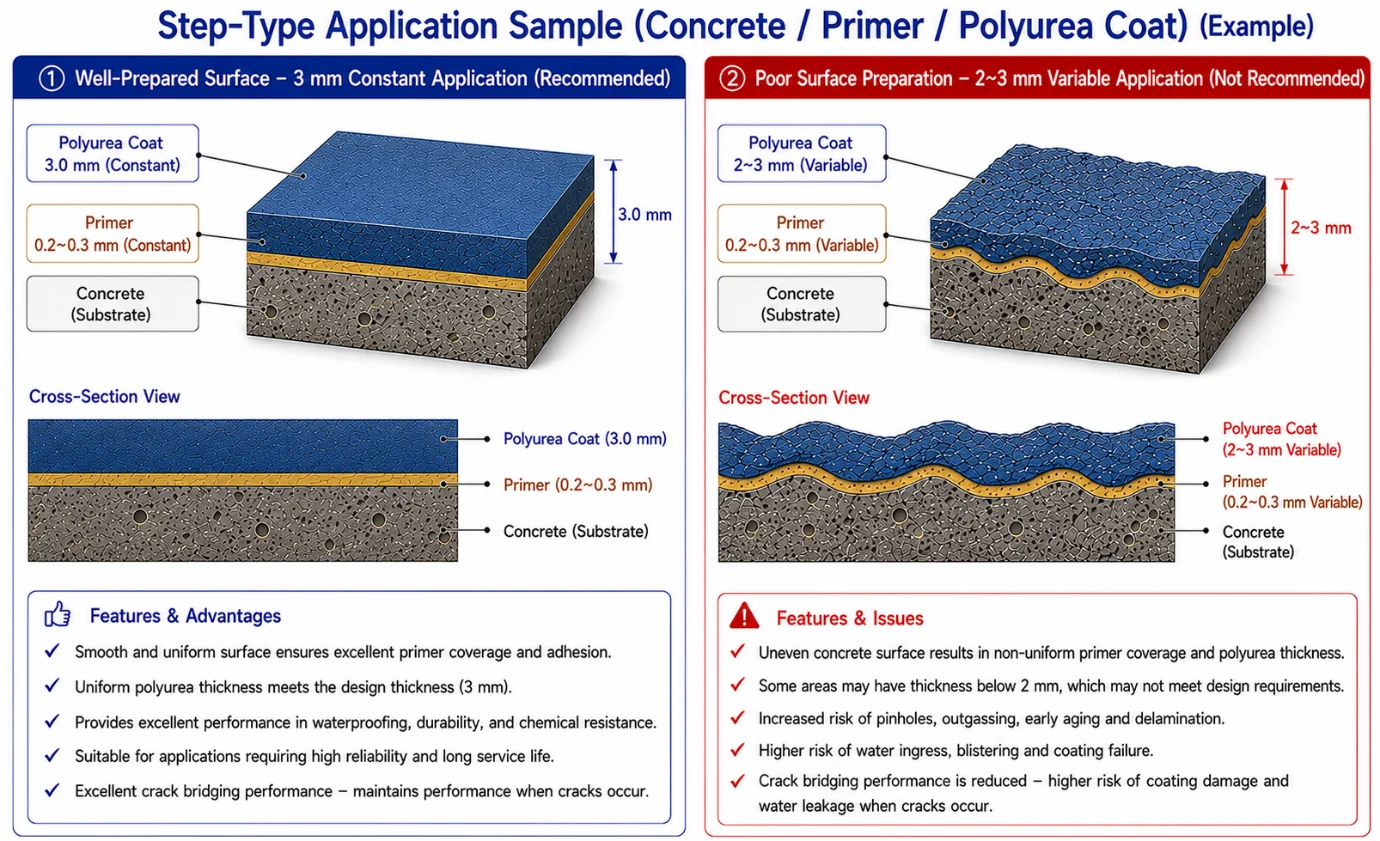
Therefore, successful application first requires designing an appropriate Spray Polyurea coating thickness that meets the required performance. Surface preparation of the substrate is also essential to ensure uniform coating thickness. As the coating is generally applied at 2–3 mm, the substrate surface must be carefully prepared to prevent irregularities and pinholes.
Adhesion is also an important factor affecting long-term durability. Accurate application that secures sufficient adhesion between each material is therefore essential.
In addition, one factor that reduces imbalance in the Spray equipment during discharge is selecting a raw material System with good Miscibility. The Spray Polyurea waterproofing system uses high-pressure Spray equipment in which Components A and B are mixed through instantaneous impingement and cure immediately upon discharge. The Instant Miscibility of the A/B raw materials is therefore extremely important.
Selecting a product such as APTECH's — proven over many years at project sites worldwide and offering a wide Process Range — can contribute to the customer's successful waterproofing application.
A. How Does Spray Polyurea Provide Waterproofing Performance?
After curing, Spray Polyurea forms a seamless membrane that blocks the pathways through which water can travel. Optimal waterproofing performance can be achieved when the following five elements are satisfied simultaneously.
- Continuous seamless membrane in all directions: selecting a Spray Polyurea product with good intercoat adhesion is important.
- Uniform coating thickness (Dry Film Thickness, DFT): the smoothness of the substrate surface and the Sprayer's skill are important.
- Application of a smooth surface without pinholes: proper substrate surface preparation and the selection of a high-quality Urea product are important.
- Excellent adhesion to the substrate: proper substrate surface preparation and the selection of a dedicated Polyurea Primer are important.
- Maximization of Crack Bridging capability: selecting a product that provides both high tensile strength and high elongation is important.
B. What Is the Relationship Between Spray Polyurea Coating Thickness, Elongation, and Tensile Strength?
As explained above, waterproofing application defects often occur not at the average thickness, but at the thinnest area (Minimum DFT).
The table below provides example data intended to help explain the differences in physical properties according to Polyurea thickness. We hope this information contributes to more precise surface preparation and Spray application.
Physical Properties and Failure Behavior of Polyurea Specimens by Thickness
| Specimen Thickness (mm) | Tensile Strength (MPa) | Elongation (%) | Laboratory Physical Property Characteristics and Failure Behavior Analysis |
|---|---|---|---|
| 0.5 | 12.5 | 180 | Initial thin-film defects: premature failure occurs due to the effects of microscopic air bubbles (pinholes) generated during spraying. |
| 1.0 | 16.2 | 260 | Transitional state: the frequency of defects is reduced, but continuous molecular chain alignment remains insufficient. |
| 1.5 | 19.8 | 340 | Entry into the standard range: stable physical properties approaching the minimum requirements for waterproofing materials under KS F 4922 are achieved. |
| 2.0 | 22.5 | 400 | Optimal maturity: the inherent properties of the polymer Bulk are expressed, achieving the optimal balance between strength and ductility. |
| 2.5 | 23.0 | 420 | Physical property saturation (Plateau): the critical point at which further increases in strength from increased thickness become negligible. |
| 3.0 | 21.8 | 390 | Effect of internal stress: heat generated by the reaction accumulates during ultra-fast curing, creating microscopic stress and resulting in a slight decrease. |
However, 2–3 mm is not a standard value applied equally to all projects. It may vary depending on the application and environment in terms of waterproofing performance, Crack Bridging, workability, and economic efficiency.
C. What Is Crack Bridging, a Key Indicator of Waterproofing Materials?
Based on the theory above, coating thickness is the most important factor in concrete waterproofing design. However, thickness is not the only variable.
Concrete substrates may develop cracks due to microcracks, contraction and expansion, and repeated loads. It is therefore very important to consider waterproofing durability in the design, and for this the concept of Crack Bridging must be understood.
Crack Bridging refers to the ability of a waterproofing layer to remain intact and bridge a crack in the substrate, preventing the layer from splitting. It involves not only coating thickness but also elongation, tensile strength, elastic modulus, adhesion, repeated loads, substrate condition, and environmental conditions.
Among these, the Spray Polyurea 3 mm Crack Bridging Test is a key indicator of the coating's crack-following performance. It verifies whether the waterproofing material can withstand an actual crack up to 3 mm wide in a substrate such as concrete without tearing.
This test differs from an elongation test that stretches the coating using a universal testing machine. It is more demanding and realistic because the waterproofing layer is bonded to the substrate as in actual application and then tested by creating an artificial crack.
Passing the 3 mm Crack Bridging Test therefore means the material is officially recognized as a high-performance material with top-level flexibility and recovery.
Comparison of Crack Bridging Performance by Waterproofing Material Type
| Waterproofing Material Type | Crack Bridging Limit (Width) | Elasticity and Elongation | Main Application Areas | Crack Response Characteristics and Limitations |
|---|---|---|---|---|
| Spray Polyurea | 2.0–3.0 mm | Very high (400%–600%) | Water tanks, bridge decks, parking garage rooftops | Excellent tensile strength and crack-following performance; used in extreme environments. (※ AP Tech. products passed the 3 mm test.) |
| Epoxy-Based (Waterproofing/Coating) | Less than 0.1 mm | Very low (0%) | Indoor parking garages, factory floors | Excellent compressive strength and abrasion resistance, but cracks together with the substrate due to zero elongation. |
| Acrylic Waterproofing | 0.5–1.5 mm | Medium (100%–200%) | Exterior walls, roof coatings | UV-resistant, but elasticity decreases at low temperatures in winter, creating a risk of tearing. |
| Liquid Waterproofing (Cementitious Liquid) | 0 mm (None) | No elasticity (0%) | Bathrooms, utility rooms, underground pits | Easily breaks even with minor structural movement or shrinkage cracks. |
| General Cementitious (Inorganic Waterproofing) | Less than 0.1–0.5 mm | Very low (0%) | Underground water tanks, interior wall waterproofing | General products have weak crack resistance and cover only microcracks. |
| Elastic Cementitious (Composite Waterproofing) | Approximately 1.0–1.5 mm | Medium (50%–100%) | Non-exposed rooftops, apartment balconies | Elasticity is improved by mixing special acrylic and synthetic rubber emulsions with cement. |
| General PU-Based (Polyurethane) | 1.5–2.5 mm | High (300%–500%) | Building rooftops, non-exposed intermediate coats | A widely used elastic waterproofing material, but with low durability. |
D. What Factors Affect the Success of Spray Polyurea Waterproofing Application?
In determining the success of a Spray Polyurea waterproofing application, it is very important to select a product that has been proven over many years at global project sites and offers a wide Process Range, such as APTECH's products.
The substrate surface must be carefully prepared to prevent the thinnest areas (Minimum DFT) and pinholes. The role of a skilled Sprayer is also very important in ensuring uniform coating thickness.
Adhesion is likewise an important factor affecting long-term durability. Accurate application that secures sufficient adhesion to each material is therefore essential.
Based on over 20 years of experience manufacturing raw materials for Spray Polyurea Coating and Polyurethane Foam Systems, APTECH provides products applicable to a wide range of applications. APTECH also supports customers' successful waterproofing applications through competitive specifications suitable for site conditions and products with a wide Process Range proven over many years at global project sites.
FAQ
Frequently Asked Questions
Spray Polyurea coatings are generally applied at approximately 2–3 mm. However, this is not a standard value applied equally to all projects and may vary depending on the application and environment.
This is because waterproofing defects often occur at Minimum DFT, the thinnest area, rather than at the average thickness.
Crack Bridging is the ability of a waterproofing layer to remain intact and act as a bridge to prevent splitting, even when a crack occurs in the substrate.
It evaluates whether the waterproofing material can safely withstand an actual crack of up to 3 mm in width in a substrate such as concrete without tearing.
A general elongation test measures the coating by stretching it using a universal testing machine. The 3 mm Crack Bridging Test attaches the waterproofing layer to the substrate in the same manner as under actual application conditions and then measures it by creating an artificial crack.
Important factors include selecting a product with a wide Process Range, surface preparation to prevent Minimum DFT and pinholes, application by a skilled Sprayer, and adhesion to the substrate.
We hope the above information helps you understand the thickness design criteria and Crack Bridging performance of Urea Coating and contributes to your work and successful waterproofing applications.