Expert knowledge and insights on polyurethane technology,
waterproofing systems, and industrial chemical solutions.
Factors Affecting PU Foam and Polyurea Coat During Spray Application
Quality Management Standards for PU Spray Foam System and Polyurea Spray Coating System

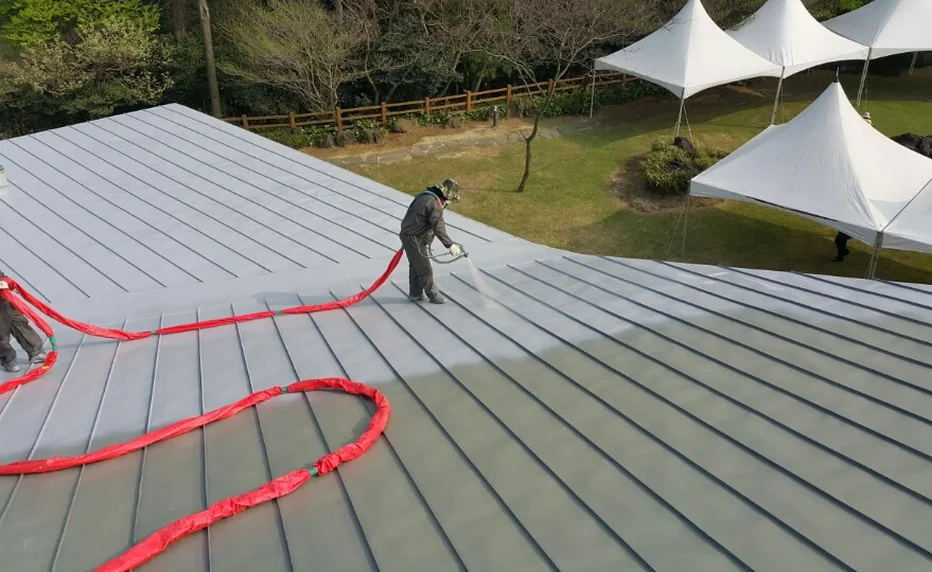
AP Tech. has been supplying Spray PU Foam and Polyurea Coat system raw materials for more than 20 years and has received favorable evaluations not only for providing consistent product quality but also for Technical Service based on extensive field experience.
Only the combination of PU/Polyurea System raw materials with a wide Process range and skilled Spray applicators can create perfect quality in field construction.
The management areas at Spray construction sites include Spray machine management, substrate management, and raw material management. Among these, Spray machine management is considered the most important.
APTECH PU Spray Foam System and Polyurea Spray Coating System are designed based on technical standards that consider various climate conditions and industrial field requirements, supporting stable Spray construction quality and long-term durability.
A. Spray Machine Management
1. Causes of A/B Ratio Unbalance and Solutions
1) Effect of MDI Residue
MDI residue is the largest factor causing blockage in the A-side Line of Spray equipment.
In other words, MDI residue accumulates in the A liquid transfer pump, Check valve, Hose inner wall, and Gun section, affecting the A/B mixing ratio during discharge.
The cause of MDI residue generation is the inherent characteristic of MDI with high chemical reactivity, and the formation route can be explained as follows.
When MDI is drawn from the drum into the machine, reaction with moisture contained in mixed air (soft state), or long-term self-reaction of MDI caused by the high heat of machine heating devices, creates hardened materials (solid state).
These materials may block the machine filter, Gun Mixing chamber, or become lodged between Check valves, thereby changing the mixing ratio during discharge.
This issue occurs frequently, especially during high-humidity summer seasons.
Normal Mixing Ratio
| Category | Details |
|---|---|
| Normal Mixing Ratio | A/B = 1:1 (V/V) |
| A Component | MDI (isocyanate) |
| B Component | Polyol (or Polyamine) System |
Abnormal Mixing Ratio
| Category | A-rich | B-rich |
|---|---|---|
| PU Foam | Shrinkage, Cell collapse, brittle | Shrinkage, Open cell, Sagging, Low strength |
| Polyurea | Increased hardness, Reduced elongation, Crack, Lighter Color | Tackiness, Uncured condition, Reduced physical properties, Poor durability, Darker Color |
APTECH supplies Spray System raw materials based on a wide Process range, considering the effect of mixing ratio deviation on field quality.
2) Effect of Machine Pressure Unbalance
| Item | Details |
|---|---|
| Symptom | Pressure increases in blocked areas |
| Action | Stop operation and remove blockage cause when A/B pressure difference exceeds 300 psi |
| Inspection Item | Confirmation of automatic stop function required |
3) Regular Inspection of A-side Line Required
MDI reacts with moisture in the air and quickly creates solid residue even in extremely small quantities.
Therefore, management during periods of non-use is important, especially during humid summer seasons when residue generation occurs more rapidly and requires special management.
It is recommended to circulate once daily, or when unused for more than one week, drain the MDI inside the Hose into a separate container for disposal, or filter and reuse depending on condition.
During long-term non-use, replacement with plasticizer or equivalent material is recommended to maintain proper machine condition.
2. Why Machine and Hose Temperature Is Important in Spray PU Foam and Polyurea Application
Raw material temperature is related to raw material viscosity and affects Spray angle and Mixing efficiency.
| Category | Spray PU Foam | Spray Polyurea |
|---|---|---|
| Machine Setting Temperature | 40~55℃ (varies depending on season and blowing agent type used) | 60~75℃ (varies depending on season) |
| Hose Setting Temperature | Recommended to be 2~5℃ higher than machine temperature | Recommended to be 2~5℃ higher than machine temperature |
3. Drum Raw Material Temperature
Importance
| Item | Details |
|---|---|
| Importance 1 | Very important for smooth transfer of raw material from transfer pump to hydraulic cylinder |
| Importance 2 | Affects Spray angle and Mixing efficiency |
| Importance 3 | During winter, large viscosity differences between A/B liquids affect the A/B mixing ratio during discharge |
Basic Setting Temperature
| Category | Temperature Condition |
|---|---|
| Spray PU Foam | 15~25℃ (varies depending on season and blowing agent type used) |
| Spray Polyurea | 25~35℃ (varies depending on season) |
Drum Band Heater is mainly installed at the lower part of the drum.
B. Substrate Management Affecting Spray Adhesion and Durability
Among all coating systems, the most important factor determining durability is adhesion to the substrate surface.
Before field construction, confirming whether the substrate surface is dry (condensation condition) and warm (above 5℃) is the key to failure-free construction.
In Spray PU Foam and Polyurea construction, not only equipment conditions but also substrate condition management is a key factor affecting long-term durability.
1. Moisture and Humidity Removal (Most Important)
| Item | Details |
|---|---|
| Moisture Effect | If water exists on the substrate surface, it reacts with MDI to generate gas, causing foam delamination and cracks |
| Condensation Effect | Adhesion decreases, causing delamination and potentially leading to Foam Crack phenomena |
| Surface Condition | Visible moisture must be absent, and the surface must not feel damp when touched |
| Dew Point Standard | Substrate temperature must be at least 3℃ higher than Dew Point |
| Pre-Construction Condition | Construction should be performed after reducing humidity using a hot air blower and Industrial Dehumidifier |
2. Surface Cleaning (Removal of Foreign Materials)
| Item | Details |
|---|---|
| Removal Targets | Dust, oil, rust, laitance (floating material on concrete surface) |
| Dust Removal | Completely remove dust using high-pressure air or vacuum cleaner |
| Oil Removal | Remove using dedicated cleaning agent |
| Effect | Reduced adhesion and possible Pin-hole generation |
For reference, when Foam construction is applied on weak concrete floor surfaces, fixing appropriate timber before Spray application may help prevent lifting or cracks.
3. Material-Specific Considerations
| Material | Condition |
|---|---|
| Concrete | Sufficient curing required, with moisture content below 5% |
| Metal | Rust must be completely removed (sanding) and anti-corrosion treatment applied |
| Wood | Apply only to sufficiently dried wood |
C. Raw Material Management Standards for Maintaining Spray Construction Quality
| Item | Details |
|---|---|
| Storage Condition | Store away from direct sunlight at approximately 20~30℃ |
| Effect of High Temperature Storage | Increased deterioration speed of A liquid, risk of swelling caused by expansion of B liquid Freon Gas |
| Transfer Pump Management | Periodic injection of TLS oil (Throat Lubrication System oil) |
| Purpose | Prevention of MDI crystallization and Seal damage |
APTECH supplies Spray PU Foam and Polyurea Systems based on Technical Service that considers raw material management, equipment conditions, and field environment.
Conclusion
Construction quality of Spray PU Foam and Polyurea Coat is not determined solely by the performance of the raw material itself.
Stable construction quality and long-term durability can be secured when Spray Machine management, substrate condition, and raw material storage conditions are managed together.
In particular, A/B liquid mixing ratio, machine pressure, temperature setting, and humidity management are key variables that directly affect construction results.
Considering both system design suitable for field conditions and Technical Service together can become the standard for securing stable Spray construction quality.
APTECH PU Spray Foam System and Polyurea Spray Coating System support stable Spray construction quality across various industrial environments based on Process range, Technical Service, and field management standards.
FAQ
APTECH Spray PU Foam & Polyurea System
Spray construction quality is determined not only by raw material quality but also by various factors including Spray Machine condition, A/B liquid mixing ratio, temperature setting, substrate condition, and raw material management. Field condition management greatly affects long-term durability and adhesion performance.
If the A/B liquid mixing ratio is not correct, problems such as Foam shrinkage, Cell collapse, uncured condition, tackiness, and reduced physical properties may occur. Maintaining an accurate 1:1 mixing ratio is essential for Spray PU Foam and Polyurea.
APTECH supplies Spray PU Foam and Polyurea System raw materials based on a wide Process range and provides Technical Service based on field experience. This allows stable construction quality to be secured in various environments.
Moisture, humidity, and temperature conditions of the substrate surface are important. The substrate surface must remain dry, and construction is recommended when the temperature is at least 3℃ higher than the Dew Point.