Expert knowledge and insights on polyurethane technology,
waterproofing systems, and industrial chemical solutions.
History and Applications of Spray PU Foam Insulation
Spray Foam Insulation — From Polyurethane History to Thermal Conductivity Comparison and APTECH Product Applications

History of Spray PU Foam — Development of Polyurethane Insulation Materials
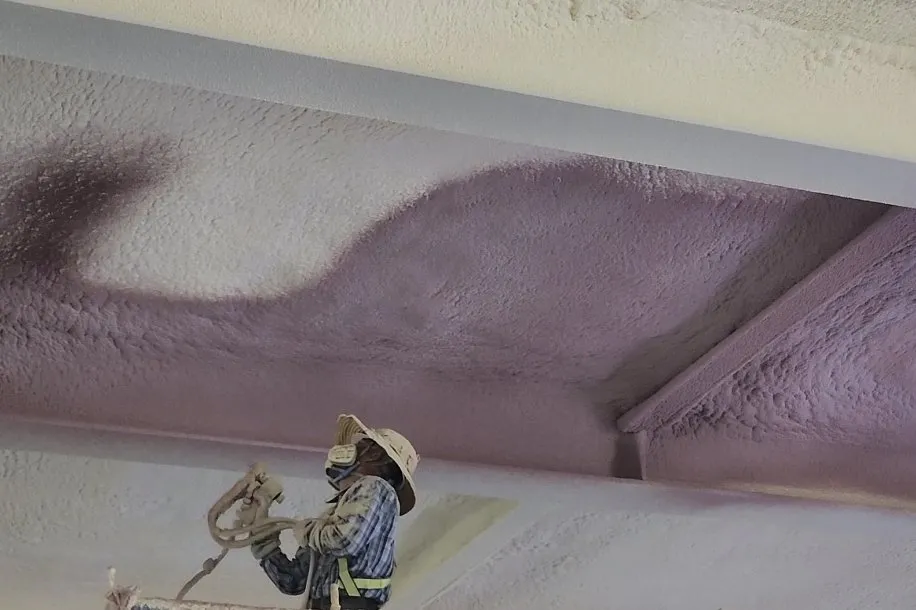
Spray PU Foam is an insulation solution developed based on Polyurethane technology and is widely used as spray foam insulation.
1937: Otto Bayer of Germany develops Polyurethane
1970–80s: Expansion of insulation material market centered on PU Panel (refrigeration/freezing/construction)
After 1990: Full-scale growth of Spray Foam insulation market
Present: Evolved into high insulation + flame retardant + eco-friendly polyurethane foam insulation
AP Tech has been supplying Spray PU Foam insulation systems since 2004, and in particular, the quasi-noncombustible urethane foam (AF-1000) product that meets Korean flame retardant standards is highly evaluated in the market.
AF-1000 is a quasi-noncombustible spray foam insulation product that secures both insulation performance and fire safety among building insulation materials.
In order to be recognized as a quasi-noncombustible insulation material in Korea, the following two tests must be passed.
KS F ISO 5660-1 (cone calorimeter heat release test)
KS F 2271 (gas toxicity test)
AF-1000 is a product that satisfies both of the above standards and is a quasi-noncombustible polyurethane foam that can be stably applied in refrigeration/freezing facilities and building insulation.
Advantages of Spray PU Foam Insulation — Why It Is Selected as Spray Foam Insulation
Spray PU Foam insulation is superior to conventional insulation materials in insulation performance, airtightness, and constructability.
1. High insulation performance (Low Thermal Conductivity)
Excellent energy saving effect
Top-level insulation performance among building materials
2. Seamless structure (Seamless Insulation)
On-site spray foaming method
Optimal for refrigeration/freezing warehouse insulation
3. Airtightness based on Closed cell structure (closed cell spray foam)
Over 90% closed cells
Waterproof + moisture-proof + air barrier
4. Adhesion to various substrates
Applicable to concrete, metal, wood, etc.
Excellent gap filling performance
5. Fast construction and adaptability to complex structures
20–30 times expansion
Applicable to irregular structures
Spray PU Foam is a high-efficiency spray foam insulation material that satisfies insulation + airtightness + moisture resistance + constructability simultaneously.
What Is Insulation? — Spray Foam Insulation Principle
Insulation is a technology that minimizes heat transfer.
The lower the thermal conductivity λ (W/m·K), the higher the insulation performance.
To achieve this, Freon gas (or liquid) is introduced into the Polyol System, and Freon gas has the lowest thermal conductivity among substances existing on earth.
The structure that can contain this Freon gas is the Closed cell of PU Foam (closed cell spray foam structure).
That is, the mechanism of PU Foam is:
Closed cell → blocking air movement → minimizing heat loss
Reasons why PU Foam insulation is excellent:
λ ≈ 0.020–0.024 (top level among building materials)
Closed cell structure (over 90%)
Seamless airtightness + moisture resistance simultaneously implemented
Thermal Conductivity Comparison — PU Foam vs XPS vs EPS
The following table compares the thermal conductivity of major building insulation materials:
| Category | Material | Thermal Conductivity (W/m·K) | Features |
|---|---|---|---|
| Organic | PU Foam | 0.020–0.025 | Optimal for cold storage & freezer |
| Organic | XPS | 0.028–0.034 | Moisture stability |
| Organic | EPS (Styrofoam) | 0.030–0.038 | Low cost |
| Organic | Wood | 0.12–0.18 | — |
| Inorganic | Glass Wool | 0.034–0.044 | Non-combustible, affected by moisture |
| Inorganic | Concrete | 1.4–2.0 | — |
| Inorganic | Steel | ~45 | — |
PU Foam demonstrates the lowest thermal conductivity among commonly used building insulation materials, making it the optimal choice for environments requiring maximum insulation performance.
Spray Foam System Products — Based on AP Tech
APTECH provides a range of Spray PU Foam products tailored to specific application environments.
General Insulation Series
Roof Waterproofing & Insulation System
| Category | Details |
|---|---|
| Products | APS-300E, APS-450E — Smooth foam surface |
| Application | Roof waterproofing, thermal storage tank waterproofing |
| Method | Foam → Coat (Polyurea) → Top Coat |
| Features | Specialized for old roof and rooftop waterproofing. Can be applied directly on panel or slate roofs without removal — highly economical system combining insulation and waterproofing. |
Anti-Condensation System
| Category | Details |
|---|---|
| Product | APS-107I (FRD 10) — Building anti-condensation application |
| Features | All Water Blowing System |
Quasi-Noncombustible Foam
| Category | Details |
|---|---|
| Product | PiR Foam (AF-1000) — Korean standard quasi-noncombustible foam |
| FRD | 35 kg/m³ |
| Application | Construction, refrigeration, and freezing applications as required by regulations |
Conclusion — Selection Criteria for Spray PU Foam Insulation
Spray PU Foam is the optimal choice under the following conditions.
Buildings requiring high insulation performance
Refrigeration/freezing facilities
Structures requiring both waterproofing and insulation
Construction environments with complex shapes
In industrial insulation, especially in refrigeration and freezing warehouses, Spray PU Foam has effectively become the standard solution.
FAQ
Frequently Asked Questions
Yes. APTECH AF-1000 is a Spray PU Foam product that meets Korean quasi-noncombustible standards and has passed KS F ISO 5660-1 and KS F 2271 tests. It secures both insulation performance and flame retardant performance.
Yes. The polyurea application method on APS-300E and APS-450E is a system that simultaneously implements roof waterproofing and insulation. The foam surface is smooth and can be directly applied on existing roofs. It is a very economical method for repairing old roofs.
Products are selected according to the usage environment. APS-24 is used for general construction, APS-26 for refrigeration, and APS-28 for freezing. For roof waterproofing, APS-300E / 450E are used, and AF-1000 is suitable when quasi-noncombustible performance is required.
Because Spray PU Foam can secure low thermal conductivity, seamless airtight structure, constructability for complex structures, and both moisture resistance and waterproof performance. Depending on the application, APS series, APS-300E / 450E, or AF-1000 can be applied.