Built on deep technical insights into urea coating, spray foam, injection, and adhesive systems, we present the differentiated value of APTECH products and the reasons they are trusted and chosen across a wide range of industrial applications.
APTECH Foam/Coat Method — Simple & Efficient Roof Insulation & Waterproofing
Spray PU Foam and Polyurea Coat System Technology Based on the Foam/Coat Method

Introduction
AP Tech has been supplying Spray PU Foam and Polyurea Coat system raw materials for more than 20 years, and has received favorable evaluations not only for providing products with a wide process range, but also for Technical Service based on various field experiences.
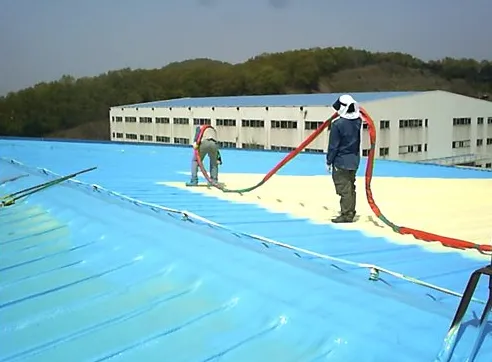
In this article, we introduce a cost-effective premium composite method consisting of Foam / Coat / Top Coat that enables very simple, convenient, environmentally friendly, and 100% waterproof construction without replacing the existing roof.
This method was named the "Foam/Coat Method" by combining Spray PU Foam, originally developed for insulation, with Polyurea, originally developed for waterproofing, to enable complete roof waterproofing. This method is based on the concept of waterproofing over the existing roof while maintaining the original roof structure.
A. Waterproofing Principle of Spray PU Foam
1. Foam Expansion Pressure Affects All Directions at 360 Degrees
1) Waterproofing Effect Penetrating Even Micro Cracks
There is a saying in the waterproofing industry: "You may know a person's mind, but you never know where water leaks." This means that when leakage occurs, it is difficult to identify where the water is actually coming from. Even if partial waterproofing is well performed, repeated thermal expansion and contraction may still cause intermittent leakage through micro cracks.
The way to fundamentally block this problem is to apply Spray PU Foam. During foaming, the expansion pressure is transmitted in all 360-degree directions, allowing complete filling from large cracks to micro cracks.
The APTECH Spray PU Foam System is a Foam/Coat Method-based system capable of filling even micro crack areas using foam expansion pressure.
2) Need for Polyurea Coat
Since the PU Foam surface absorbs water while being degraded by ultraviolet rays, it is necessary to apply Spray Polyurea Coat, which is a complete waterproofing material, over the surface.
2. Spray Foam Can Be Applied at a Uniform Thickness Regardless of Substrate Structure
1) Applicable to Curved Surfaces
One advantage of Spray Foam is its fast curing property, allowing uniform thickness application not only on flat surfaces but also on curved surfaces, vertical surfaces, and uneven areas. It not only penetrates and fills crack areas on the substrate surface, but also creates a relatively smooth Foam surface, enabling acceptable exterior appearance. Therefore, it can be applied to both inclined panel roofs and slate roofs.
2) Applicable to Wall Construction
In large poultry farms equipped with automatic temperature and humidity control systems, Spray PU Foam is applied not only for roof waterproofing but also for insulation on interior walls and ceilings, followed by full Spray Polyurea coating. In some cases, for economic reasons, Polyurea is applied only up to approximately 1m from the floor.
B. Waterproofing Principle of Spray Polyurea
1. Best Physical Properties Among Waterproofing Materials
Among various waterproofing materials, Polyurea is the only product that simultaneously satisfies both elongation and tensile strength. General waterproofing coatings or sealants tend to have low tensile strength when elongation is good, and reduced elongation when tensile strength is high.
Polyurea simultaneously satisfies elongation and tensile strength while also providing excellent durability as a seamless waterproofing material. However, Top Coat application is required to prevent discoloration and improve durability of Polyurea.
The APTECH Polyurea Coat System is a waterproofing system designed to secure durability while simultaneously satisfying elongation and tensile strength.
2. Uniform Thickness Regardless of Substrate Structure
Spray Polyurea also has fast curing properties, allowing uniform application thickness on flat surfaces, curved surfaces, vertical surfaces, and uneven areas. Especially when sprayed over Foam, it also provides the effect of partially filling uneven Foam surface areas, resulting in an aesthetically improved appearance.
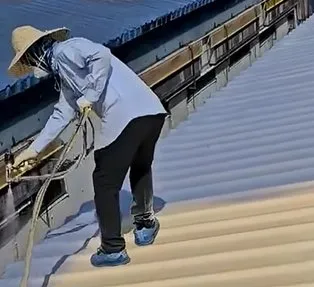
Foam and Coat Construction Scene
C. Foam/Coat/Top Coat Application Structure
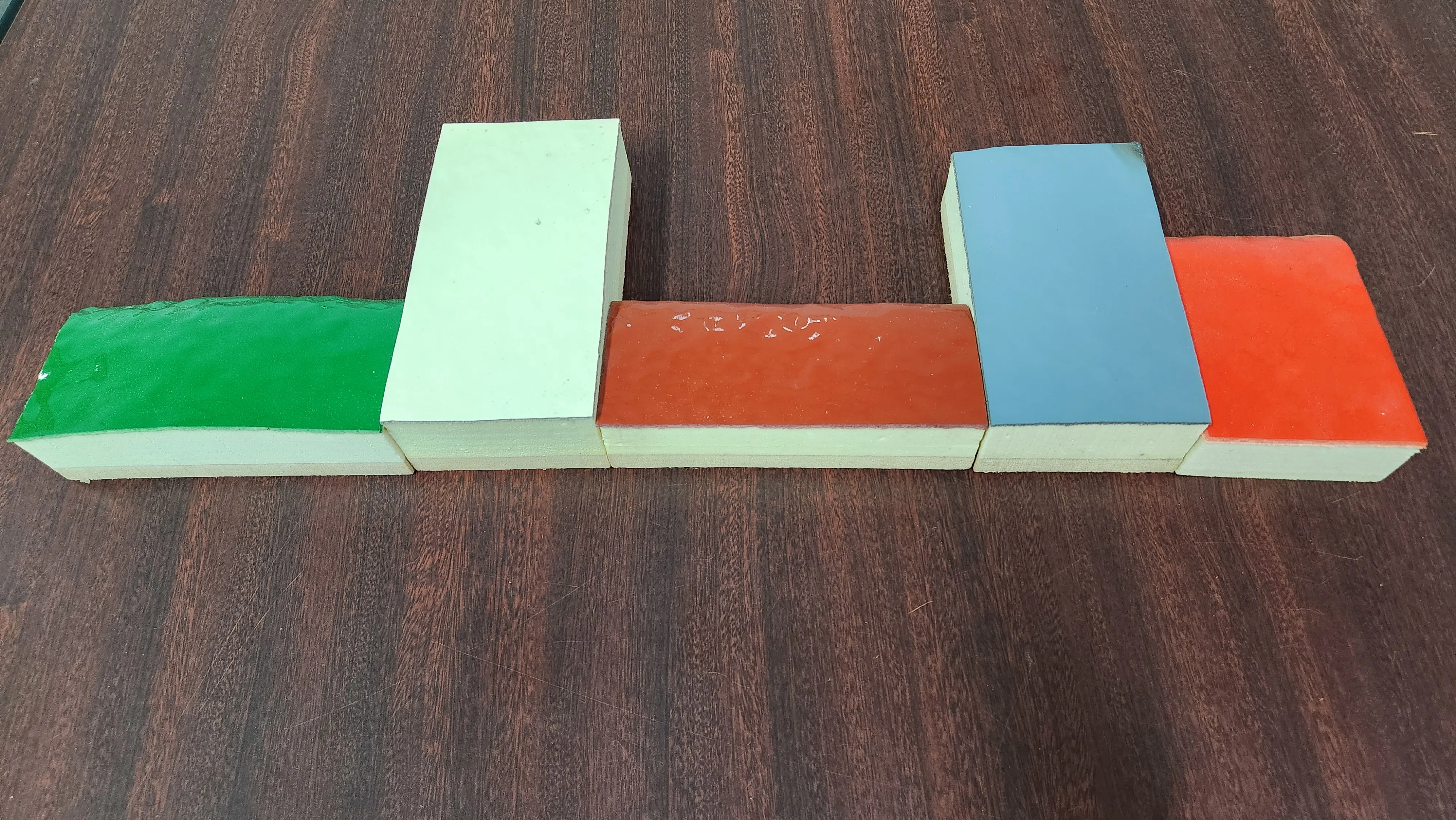
Foam and Coat Color Samples
1. Inclined Roof Area (Non-Walkable Area)
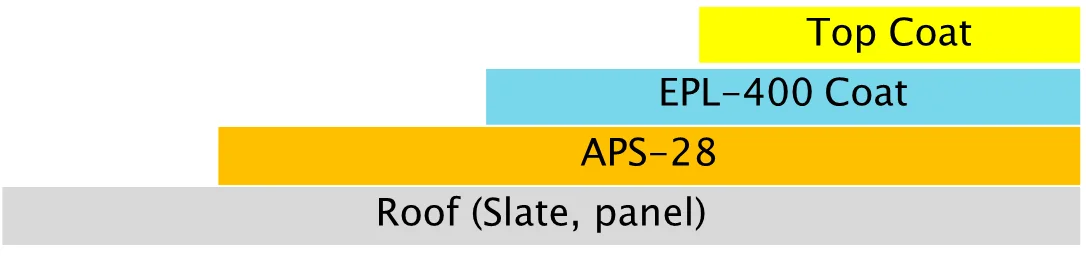
General Construction Method
APS-28 (Foam) / UA-1001 (Pure Polyurea) or EPL-400 (Hybrid Coat) / TP-200 (Top Coat)
Flame-Retardant Material Construction Method
(When Flame-Retardant Requirements Exist Within Industrial Complexes)
AF-1000 (Quasi-noncombustible Foam) / EPL-270 (Flame-retardant Hybrid Coat) / TP-200 (Top Coat)
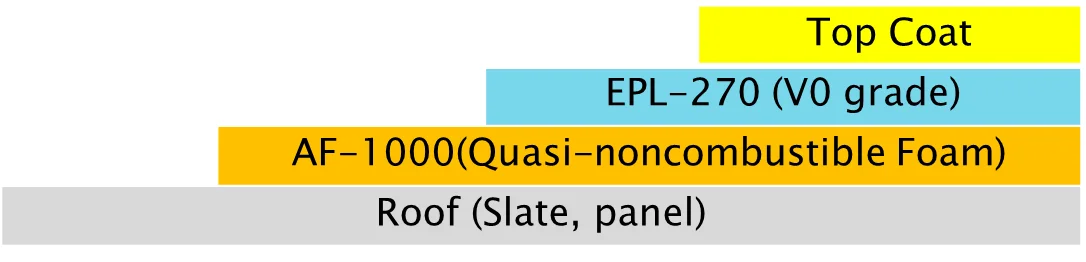
Material Thickness
| Material | Thickness |
|---|---|
| Foam | 3 cm |
| Pure Polyurea | 2–3 mm |
| Top Coat | Approx. 0.1 mm |
Top Coat protects Polyurea, which is vulnerable to ultraviolet rays, therefore re-coating is recommended every 2–3 years. This not only helps extend waterproofing service life, but also helps maintain an aesthetically pleasing appearance.
2. Flat Slab Roof (Light Walkable Area)
Specification
| Process | Product |
|---|---|
| Foam | APS-450E (High-density Foam) |
| Polyurea | UA-1001 (Pure Polyurea) or EPL-400 (Hybrid Coat) |
| Top Coat | TP-200 (Top Coat) |
APS-450E, UA-1001, EPL-400 and TP-200 are major systems applied to the APTECH Foam/Coat Method.
Precautions for Flat Slab Roof
• Slab roofs must be constructed up to the Parapet inner wall and upper Parapet area (Coping) to achieve complete waterproofing.
• Foam construction should begin from the area where the slab floor and the Parapet inner wall meet by first applying Foam construction (corner filling, arris fillet) before continuing.
• The Foam/Coat Method is not recommended for areas with heavy pedestrian traffic. The general waterproofing method using Primer / Polyurea / Top Coat after concrete finishing work is recommended.
D. Precautions During Spray Construction
1. Substrate Surface and Precautions Before Construction
| Item | Details |
|---|---|
| Steel Surface | Completely remove rust using a high-pressure washer or grinder |
| Existing Coating | Remove lifted or peeled existing paint |
| Moisture | Construct only after complete drying |
| Cracks and Holes | Pre-repair with sealant |
| Aged Roof | Pre-check Foam/Coat weight |
| Spray dust | Protective covering work such as dust prevention sheets required |
Because it is a Spray application method, Spray dust may be blown by the wind and adhere to nearby vehicles or adjacent buildings, causing contamination damage. In urban areas or locations with many vehicles, protective covering work using dust prevention sheets is essential.
2. Need for Skilled Spray Applicators
Since A/B liquids (main agent/curing agent) must be accurately mixed and sprayed at a 1:1 ratio at the end of the Gun, precise equipment setting is required. Depending on the skill level of the applicator, differences in Foam surface flatness or Polyurea thickness deviation may occur.
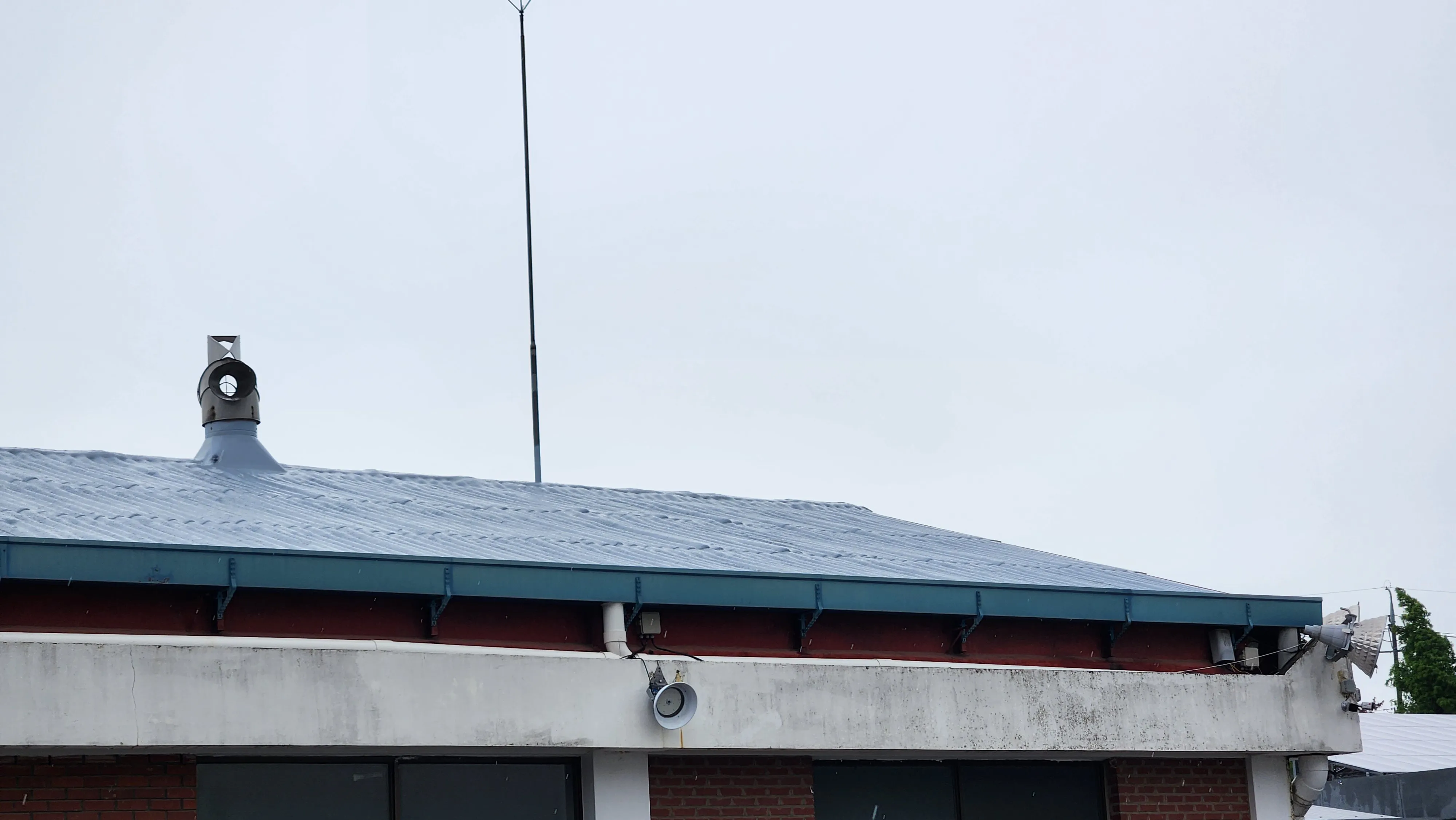
Roof Photo After Foam and Coat Construction
Conclusion
The APTECH Foam/Coat Method is a composite method that simultaneously implements insulation and waterproofing by applying Spray PU Foam and Polyurea Coat without replacing the existing roof.
Since the construction is quietly performed on the roof regardless of building interior use, it is widely applied not only to general buildings but also to livestock barns, poultry farms, and factories within old industrial complexes.
In addition, energy-saving effects can be expected due to the insulation material blocking solar heat. We hope this information will be helpful to your work.
FAQ
Frequently Asked Questions
Yes. Construction is possible by applying Spray PU Foam and Polyurea Coat while maintaining the existing roof structure.
Since the PU Foam surface absorbs water while being degraded by ultraviolet rays, Spray Polyurea Coat application is required to secure complete waterproofing performance.
It can be applied not only to general buildings, but also to livestock barns, poultry farms, and factories within old industrial complexes where maintaining the existing roof is required.
It is a composite waterproofing system that simultaneously applies the insulation performance of Spray PU Foam and the waterproofing performance of Polyurea, enabling both insulation and waterproofing without replacing the existing roof.