Expert knowledge and insights on polyurethane technology,
waterproofing systems, and industrial chemical solutions.
Rigid PIR Foam System Design — Comparing Korean Semi-Noncombustibility Requirements with International Fire Standards, and the Optimal Isocyanate Index Range
Korean semi-noncombustible fire test standards, an international comparison, and the optimal Isocyanate Index range for fire-safe rigid PIR foam insulation

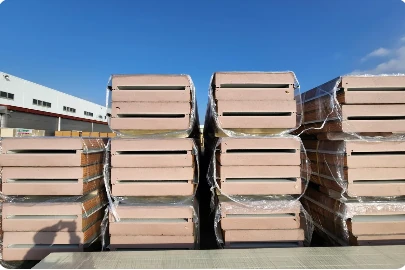
APTECH has developed and supplied raw material systems for Spray Polyurea Coating and Polyurethane Foam Systems for over 20 years. The company is well regarded for its wide product range and competitive specifications tailored to field conditions.
In this issue, we examine the key factors in designing Rigid PIR (Polyisocyanurate) Foam Systems for building insulation applications requiring fire safety. We compare Korea’s semi-noncombustibility requirements with international fire performance standards and review the derivation and optimal range of the Isocyanate Index, a key parameter in PIR Foam System design, to guide effective fire-resistant design.
Korean KS standards for PU/PIR Foam were long based on KS M 3809, focusing on physical properties and combustion characteristics. Following the consolidated revision to KS M ISO 4898 in 2024, insulation quality standards were aligned with international standards, while performance-based fire safety tests, including KS F ISO 5660-1 (Cone Calorimeter Test) and KS F 2271 (Gas Toxicity Test), gained greater importance under Korea’s building material quality recognition system. As a result, Korea’s semi-noncombustibility requirements now demand a high level of fire safety performance by international standards.
In response to these market and regulatory changes, APTECH has supplied Spray Foam System AF-1000 and Continuous Panel Foam System APP-600C, which meet Korea’s semi-noncombustibility requirements, since 2004. Both products are used in various building insulation applications and have earned customer trust for their excellent fire performance, stability, workability, and consistent quality.
1. Key Test Standards for Semi-Noncombustible Insulation Materials in Korea
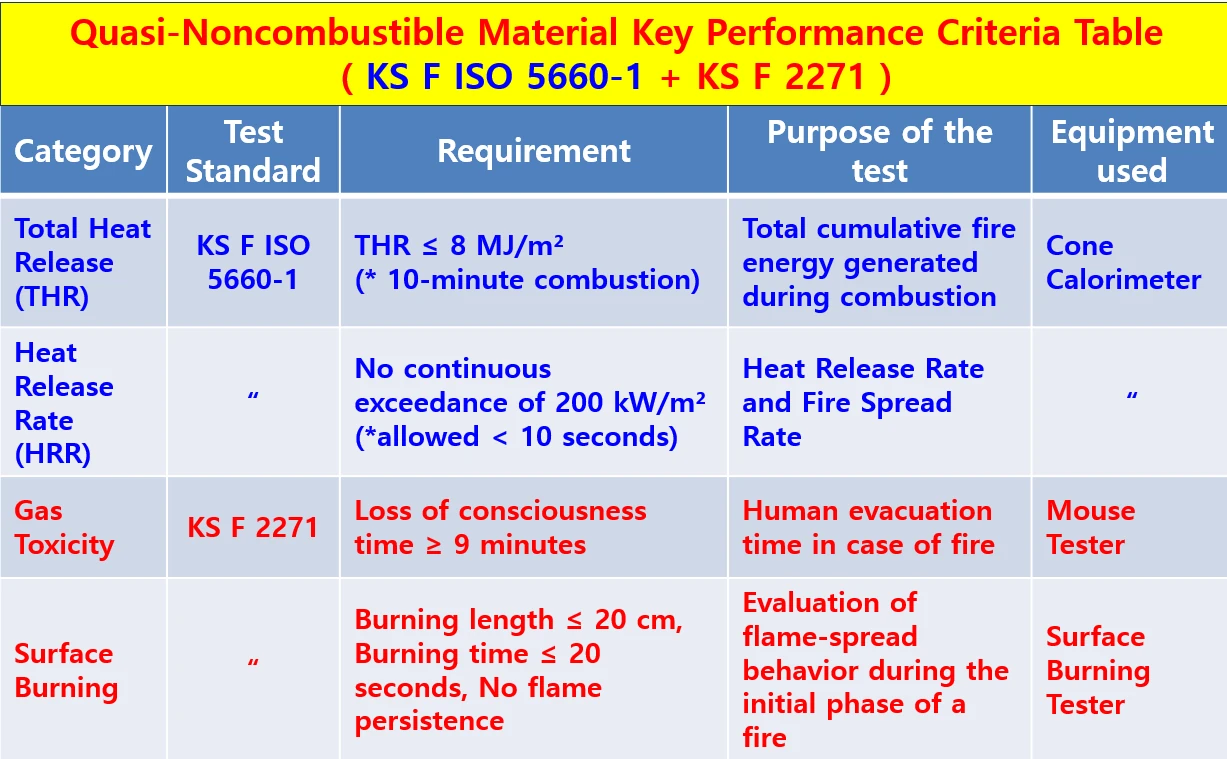
Semi-noncombustible insulation materials in Korea must meet strict fire safety requirements, including two or three of the following test standards, depending on the application.
① KS F ISO 5660-1 – Cone Calorimeter Test
- Total Heat Release (THR)
- Heat Release Rate (HRR)
② KS F 2271 – Surface Burning and Gas Toxicity Test (Mouse Test)
③ Full-Scale Fire Test
- Composite materials such as sandwich panels: KS F ISO 13784-1
- Exterior wall cladding and insulation systems: KS F 8414
This article focuses primarily on ① the Cone Calorimeter Test and ② the Gas Toxicity Test.
Technical Challenges in Developing Semi-Noncombustible PIR Foam in Korea
One of the greatest challenges for PIR Foam System developers is meeting both of the following requirements when testing the core material alone, without the steel facings of composite panels:
- Total Heat Release (THR): ≤ 8 MJ/m²
- Gas Toxicity Test: Average time to incapacitation of mice ≥ 9 minutes
A distinctive feature of Korean fire performance standards is the Gas Toxicity Test (Mouse Test). This bioassay evaluates the toxicity of combustion gases, including CO, CO₂, HCN, HCHO, and NOx, by measuring the time to incapacitation of mice exposed to these gases during a fire.
Therefore, meeting both the total heat release and gas toxicity requirements is a critical technical challenge in the formulation and development of semi-noncombustible rigid PIR Foam Systems.
The following table summarizes these key test standards and their characteristics for easy comparison.
2. Cone Calorimeter Components and Test Principles – KS F ISO 5660-1
The following photo shows the conical heater of a Cone Calorimeter, which applies a radiant heat flux of 50 kW/m².
A radiant heat flux of 50 kW/m² corresponds to blackbody radiation from a surface at approximately 700°C.
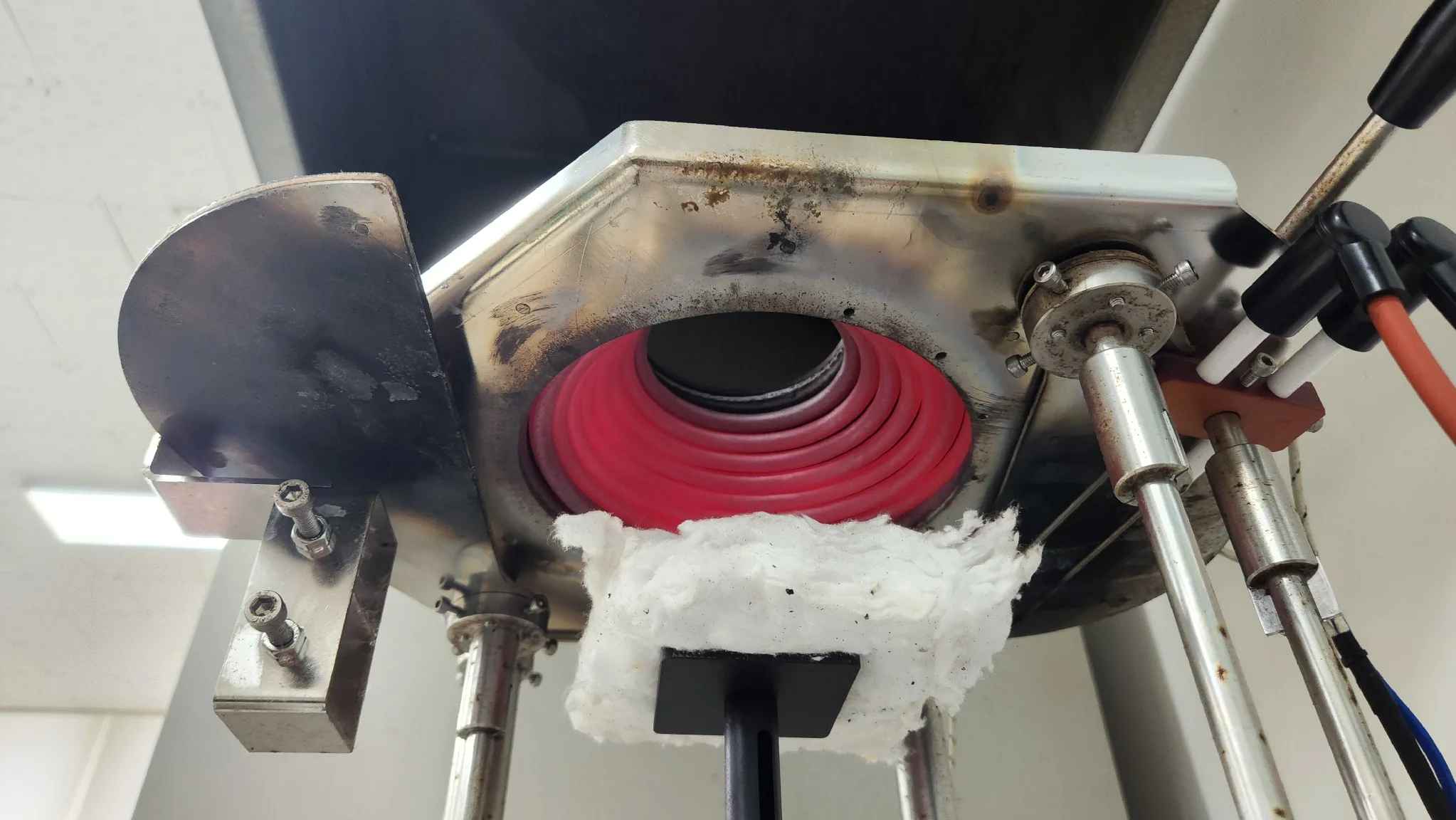
The Cone Calorimeter Test (KS F ISO 5660-1) is a fire performance test that quantitatively evaluates Heat Release Rate (HRR), Total Heat Release (THR), Mass Loss Rate, and smoke generation characteristics during combustion, rather than simply burning a specimen.
It is a key test for evaluating the fire performance of semi-noncombustible insulation materials, including rigid PIR Foam. Its main components and functions are as follows:
- Conical Heater: Provides a constant external radiant heat flux.
- Specimen Holder: Holds the test specimen in place.
- Spark Igniter: Ignites flammable pyrolysis gases released from the specimen (radiant heat: 50kW).
- Exhaust Hood & Duct: Collects combustion gases and smoke and measures exhaust flow rate.
- O₂ Analyzer: Calculates Heat Release Rate (HRR) from oxygen consumption and Total Heat Release (THR) through integration.
- Load Cell: Measures the specimen's Mass Loss Rate during combustion.
- Smoke Measurement System: Measures smoke generation and production characteristics using optical methods.
APTECH AF-1000 Semi-Noncombustible Foam Fire Test Using a Cone Calorimeter
The following images are captured from a video of APTECH's AF-1000 Spray Foam being tested in accordance with KS F ISO 5660-1 (Cone Calorimeter Test).
The full test video is available on APTECH's official website and YouTube channel.
- Official Website: www.aptech-polyurethane.com → Application → Videos
- YouTube: @aptech.polyurethane
- Video Title: AF-1000 Spray Foam Fire Safety Test
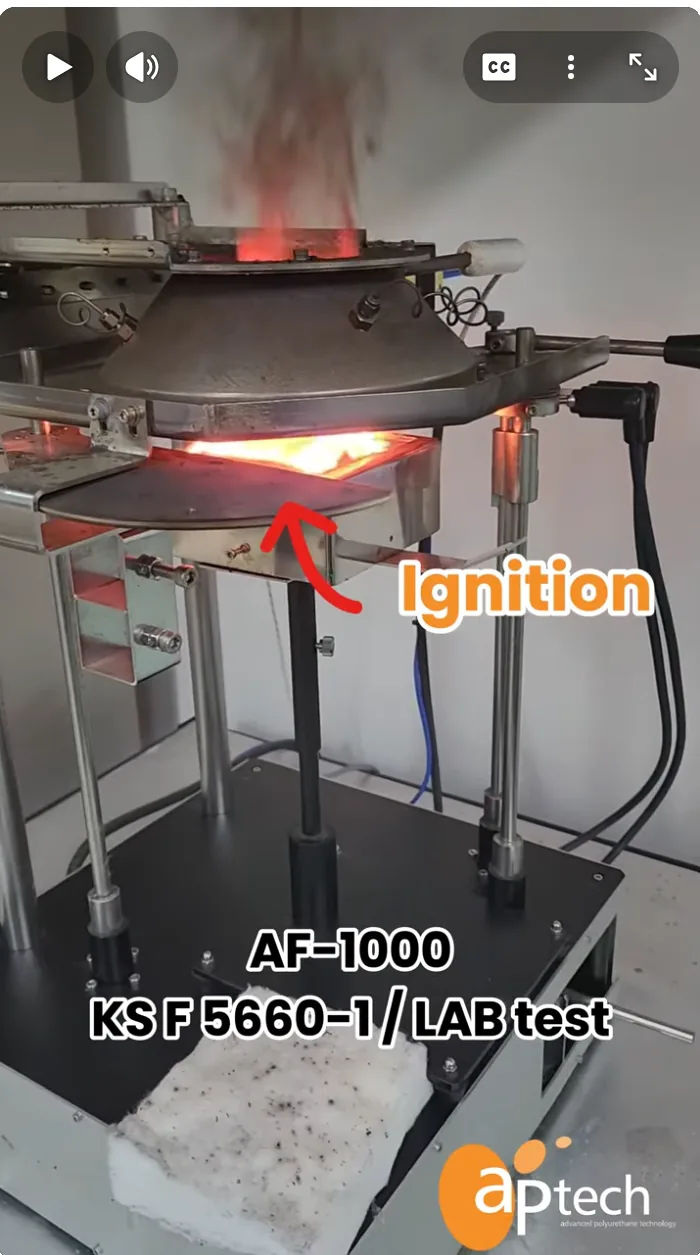
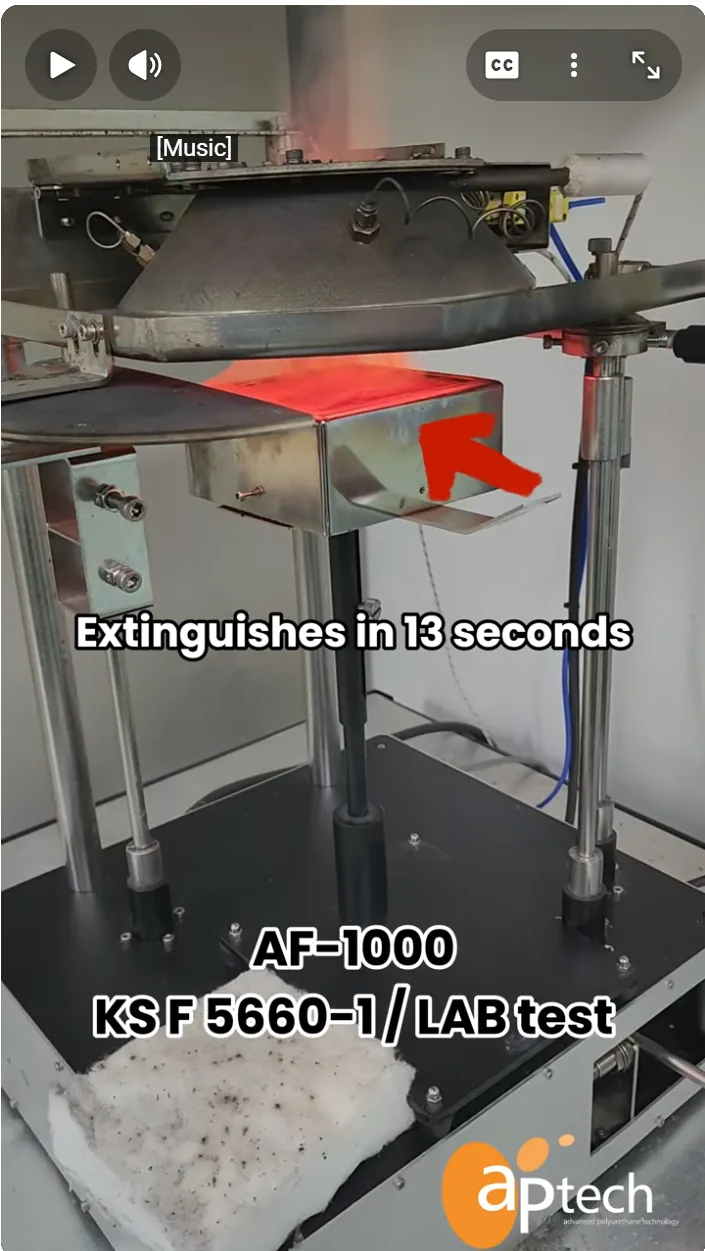
Start of Test Flame Extinguished After 13 Seconds
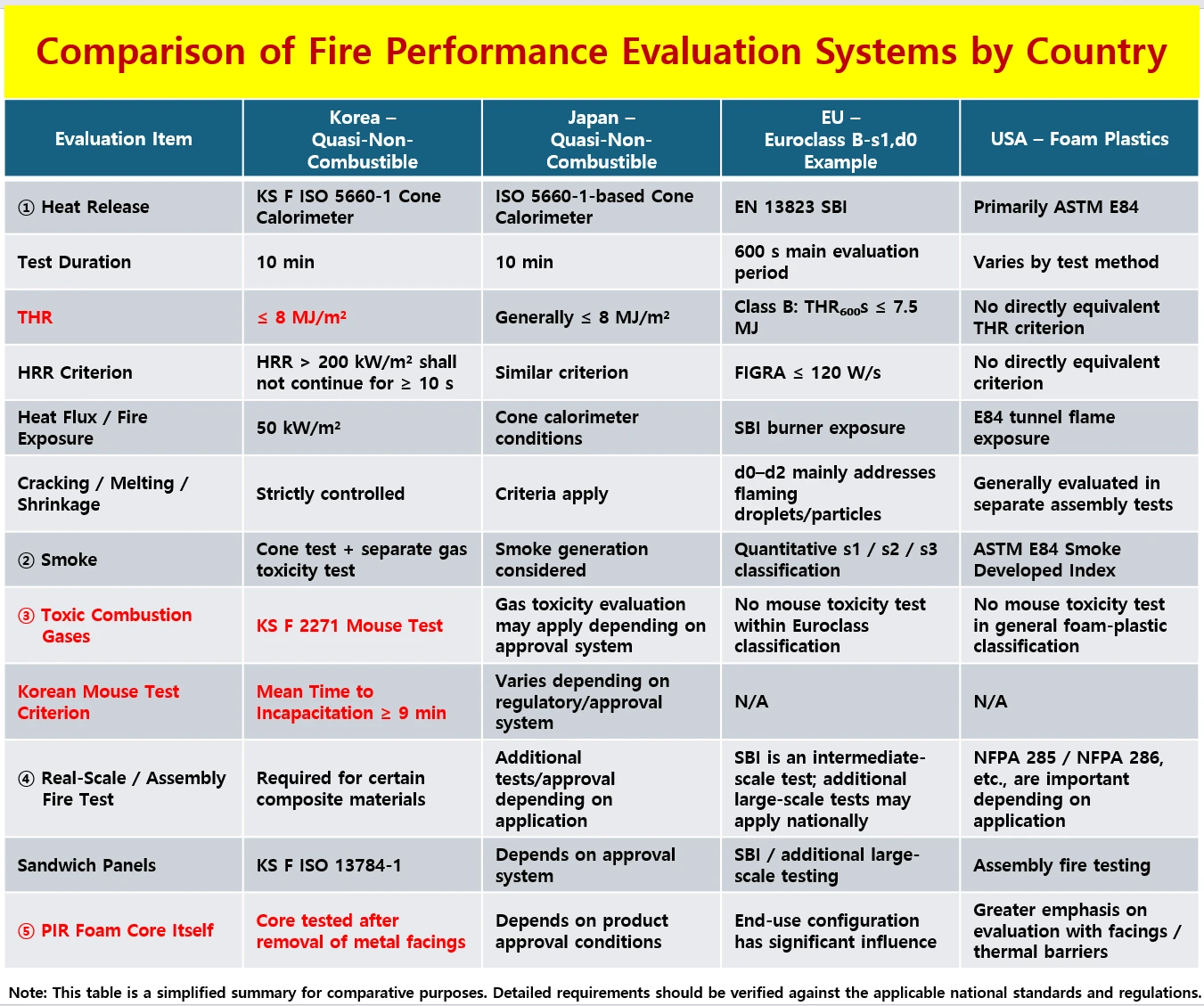
3. Comparison of Major Fire Safety Performance Standards – Korea, Japan, Europe, and the United States
To compare Korea’s semi-noncombustibility requirements for insulation materials with international fire safety and fire performance standards, the evaluation systems of Korea, Japan, Europe, and the United States are summarized by key test items and assessment criteria.
4. Key Considerations in PIR Foam System Design
Rigid PIR Foam System design is a complex engineering process that requires consideration of chemical reaction design, physical property control (shrinkage and mechanical strength), fire performance (compliance with fire safety standards), process stability, and productivity improvement.
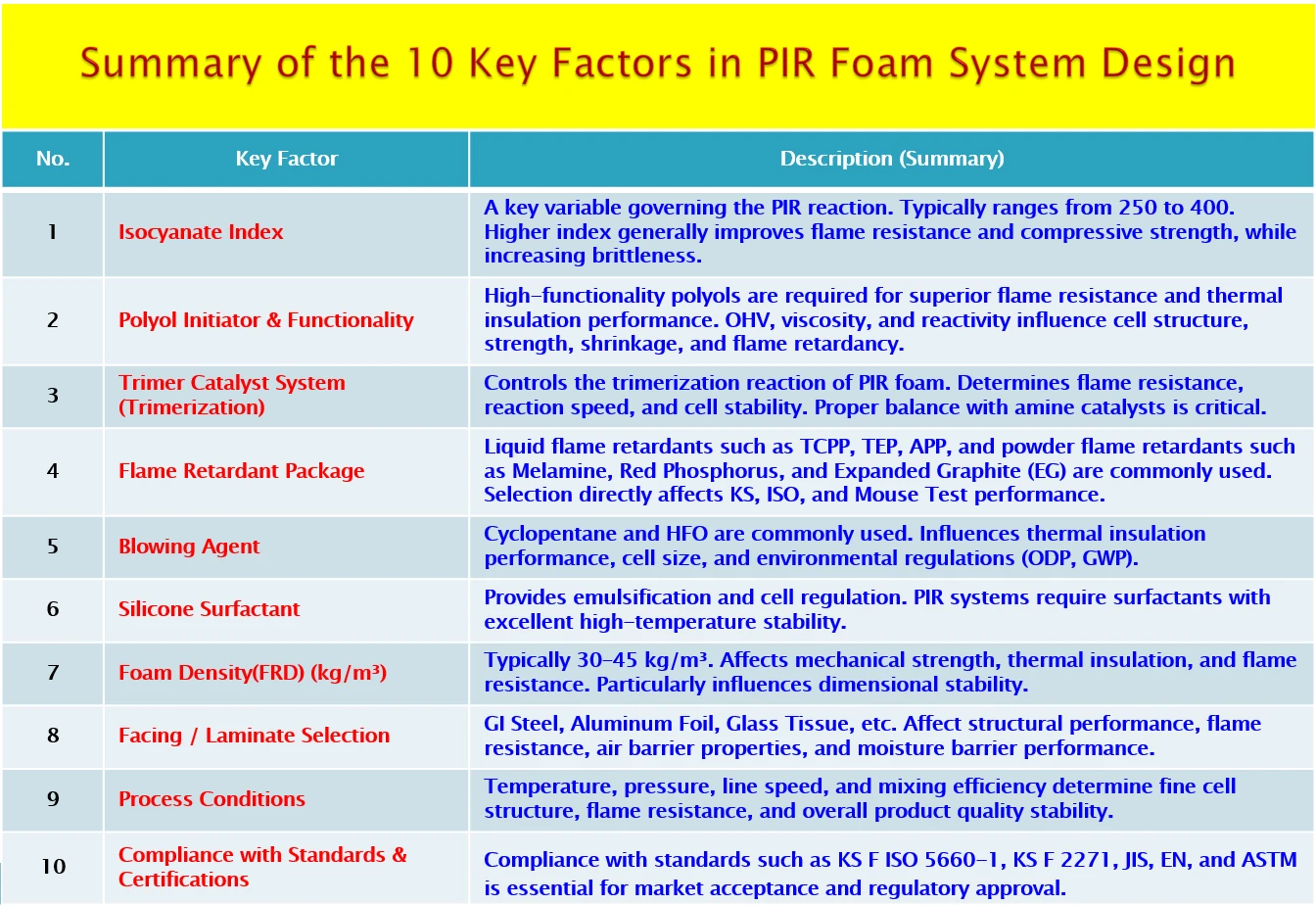
The key design factors affecting PIR Foam performance and quality are classified into 10 categories. This article focuses particularly on the concept and optimal application range of the Isocyanate Index, which is closely related to fire performance.
A: 10 Key Factors in PIR Foam System Design
B: Key Variable in PIR Foam Design – Isocyanate Index
The Isocyanate Index is a key design parameter that determines the fire performance and physical properties of rigid PIR Foam Systems. It is generally set within the range of 250–400. As the Index increases, the proportion of Isocyanurate structures rises, generally improving fire and heat resistance.
However, excessive crosslinking can increase foam brittleness and friability.
As the Index increases, the proportion of Isocyanurate structures rises, generally improving fire and heat resistance.
Therefore, selecting an optimal Isocyanate Index that balances fire performance, mechanical properties, and processability is essential in PIR Foam System design.
In the industry, an Index of 300–350 is generally considered the most suitable range for semi-noncombustibility performance and workability. The theoretical basis for this range is discussed below.
1) Derivation of the Isocyanate Index Formula
First, we examine the calculation principles and derivation of the Isocyanate Index. By applying these equations in Excel, raw material mixing ratios for a target Isocyanate Index can be easily calculated and used to efficiently design various PIR Foam Formulations.
The basic equivalent reaction principle of PU is:
Meq = Peq
Applying the Isocyanate Index:
NCO equivalents = (Index / 100) × OH equivalents
Using the mass and equivalent weight of each raw material:
NCO equivalents = Mg / Mew
OH equivalents = Pg / Pew
Therefore:
Mg / Mew = (Index / 100) × Pg / Pew
Where:
- Mg: MDI mass (g)
- Mew: MDI Equivalent Weight
- Pg: Polyol mass (g)
- Pew: Polyol Equivalent Weight
Based on this relationship, the formula for calculating raw material mixing ratios at a target Isocyanate Index can be derived as follows.
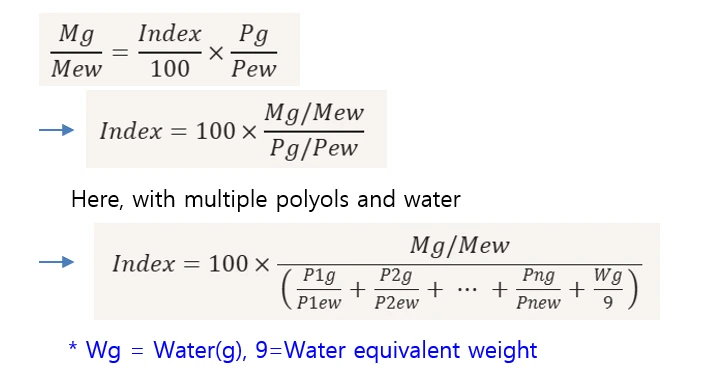
2) Technical and Economic Feasibility of the Isocyanate Index Range of 300–350
Conventional PUR Foam (Polyurethane Foam) is typically designed with an Isocyanate Index of 100–120, whereas PIR Foam (Polyisocyanurate Foam) uses excess MDI to increase the Index and promote Isocyanurate formation. However, excessive MDI can cause process control difficulties and reduced productivity. Therefore, selecting an optimal Isocyanate Index is important for balancing fire performance and production efficiency.
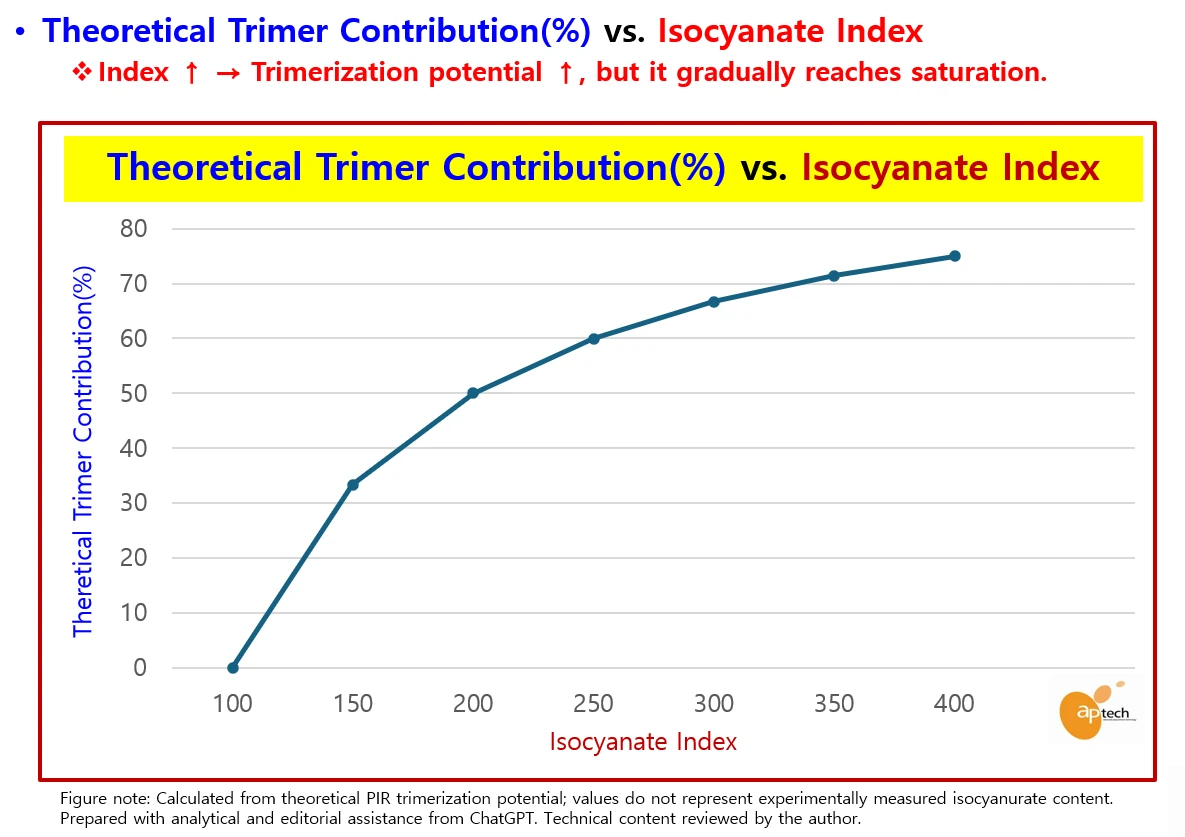
To examine the theoretical basis for the optimal Index range, calculations on the relationship between the Isocyanate Index and Theoretical Trimer Contribution were conducted with ChatGPT. This technical analysis combines the author's experience in production efficiency and optimal Index selection since 1989 with theoretical calculations performed by ChatGPT, providing an interesting and impressive technical review.
The theoretical changes in trimerization contribution across different Index ranges are as follows:
- Index 100 → 200: Trimerization potential increases rapidly.
- Index 200 → 300: A significant increase continues.
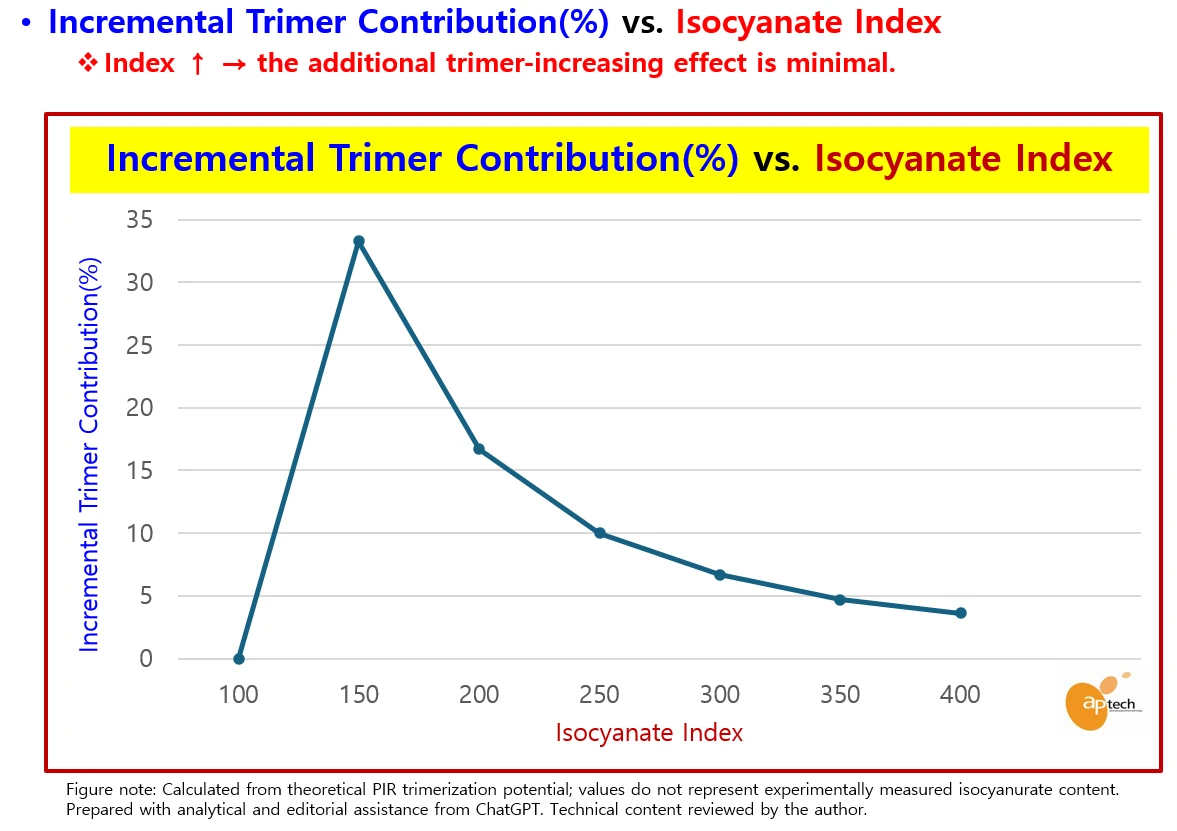
- Index 300 → 350: The increase continues, but marginal benefits decline substantially.
- Index 350 → 400: Additional theoretical trimer contribution becomes limited relative to the increase in Index.
However, this theoretical analysis alone cannot establish Index 300–350 as the optimal range for all PIR Foam Systems. Actual formulation design must consider the balance among reactivity, shrinkage, adhesion, process stability, surface smoothness of the final product, and the types and concentrations of flame retardants and catalysts.
The following two graphs illustrate the changes in theoretical trimer contribution with increasing Isocyanate Index.
1. Relationship Between Theoretical Trimer Contribution (%) and Isocyanate Index
Incremental Trimer Contribution(%) vs. Isocyanate Index
2. Incremental Trimer Contribution (%) and Isocyanate Index Control
We hope that the fire performance evaluation standards and optimal Isocyanate Index design guidelines for rigid PIR Foam Systems discussed in this article will serve as a useful reference for our customers’ product development and practical applications.
FAQ
Rigid PIR Foam System & Semi-Noncombustibility
PIR Foam is a rigid insulation material containing Isocyanurate structures formed through the trimerization of isocyanates. It uses a higher Isocyanate Index than conventional PUR Foam and is used in building insulation and sandwich panels to improve heat resistance and fire performance.
Key tests for semi-noncombustible insulation in Korea include the Cone Calorimeter Test (KS F ISO 5660-1) and Gas Toxicity Test (KS F 2271). Major criteria include Total Heat Release (THR) of 8 MJ/m² or less over 10 minutes and an average time to incapacitation of mice of at least 9 minutes. Additional requirements may apply depending on the material.
The Isocyanate Index indicates the ratio of isocyanate (NCO) equivalents to active hydrogen equivalents in polyurethane reactions. In PIR Foam, a higher Index can promote Isocyanurate formation and improve fire and heat resistance. However, an excessively high Index may cause brittleness and processing difficulties.
An Index of 300–350 is considered a key design range when balancing fire performance, mechanical properties, and process stability. However, the optimal Index depends on the types of MDI, polyols, flame retardants, and catalysts, as well as formulation conditions, and must be verified through actual testing.
The Cone Calorimeter Test (KS F ISO 5660-1) evaluates fire performance by applying a constant radiant heat flux and measuring Heat Release Rate (HRR), Total Heat Release (THR), Mass Loss Rate, and smoke generation characteristics. It is one of the main tests used to evaluate the fire performance of semi-noncombustible insulation materials in Korea.
No. Increasing the Isocyanate Index can promote Isocyanurate formation, but excessive increases may cause foam brittleness, shrinkage, and production process issues. Therefore, formulation design must consider the types and concentrations of flame retardants and catalysts, reactivity, and mechanical properties.
APTECH supplies AF-1000 Spray Foam System and APP-600C Continuous Panel Foam System for building insulation applications. Both products were developed to meet Korea’s semi-noncombustibility performance requirements and are polyurethane foam solutions designed for fire performance, stable workability, and consistent quality.
The AF-1000 Spray Foam Fire Safety Test video is available on APTECH’s official website (www.aptech-polyurethane.com) under Application → Videos, or on its official YouTube channel (@aptech.polyurethane). The video shows the KS F ISO 5660-1 Cone Calorimeter Test procedure.