Expert knowledge and insights on polyurethane technology,
waterproofing systems, and industrial chemical solutions.
Prepolymer Design, Dimer Formation, and Pure MDI Handling You Must Understand for Polyurea and Polyurethane Manufacturing
Essential Guide to PU Prepolymer Design, Dimer (Uretdione) Formation, and Pure MDI Storage & Handling

Products used across various industries—including Polyurea Coating, Polyurethane Waterproofing, Adhesives, Sealants, Elastomers, TPU, and Shoe Soles—may appear to be completely different products, yet they all share one critical technical component.
That component is PU Prepolymer (Polyurethane Prepolymer).
In actual manufacturing environments, it is common to experience changes in physical properties, increased viscosity, or storage-related quality issues even when the same raw materials are used.
Most of these issues are directly related to Prepolymer design and the proper handling of Pure MDI.
With more than 20 years of experience manufacturing Spray Polyurea Coating Systems and Polyurethane Foam Systems, APTECH has accumulated extensive expertise in Prepolymer technology applicable to a wide range of industrial applications.
In this column, we will explain the manufacturing process of PU Prepolymers and the precautions that should be taken when using Pure MDI.
Why Is PU Prepolymer Used?
Many people initially ask the following question:
"Why can't MDI and Polyol simply be used directly?"
The answer is that, in most Polyurea and CASE Polyurethane applications, this is not practical.
The primary purpose of manufacturing a Prepolymer is to design the mechanical properties of the final product.
Depending on the structure of the Prepolymer, the following properties are determined:
• Hardness and Tensile Strength
• Elongation
• Elasticity
• Storage Stability
• Processability
Therefore, a PU Prepolymer should not be regarded as merely an intermediate material, but rather as a product that embodies the core formulation technology of each manufacturer.
APTECH's Prepolymer for Urea Coating Systems also provides excellent mechanical properties while ensuring more than one year of storage stability.
Where Are MDI and TDI Prepolymers Used?
The application varies depending on the type of Isocyanate used.
Examples of Raw Materials and Applications for MDI and TDI Prepolymers
| Items | Pure MDI | Pure MDI | TDI |
|---|---|---|---|
| Polyol Used | PPG | Polyester | PPG |
| Functionality (f) | Diol, Triol | Diol | Diol, Triol |
| Initiator Structure | DPG, Glycerine, PTMEG | AA+EG, AA+DEG, AA+1,4-BG, NPG | DPG, Glycerine, TMP |
| Main Applications | |||
| 2K (2-Component) | Spray Polyurea, Automotive Interior | Shoe Soles, Adhesives | PU Floor Waterproofing, PU Top Coat |
| 1K (1-Component) | PU, Spandex, TPU | Synthetic Leather, TPU | PU Primer |
How Is PU Prepolymer Manufactured?
Manufacturing a PU Prepolymer is not simply a mixing process. It is a chemical reaction process that requires strict control of temperature, moisture, and raw material conditions.
How Is the Reaction System Configured?
PU Prepolymer Laboratory Reaction Apparatus Setup
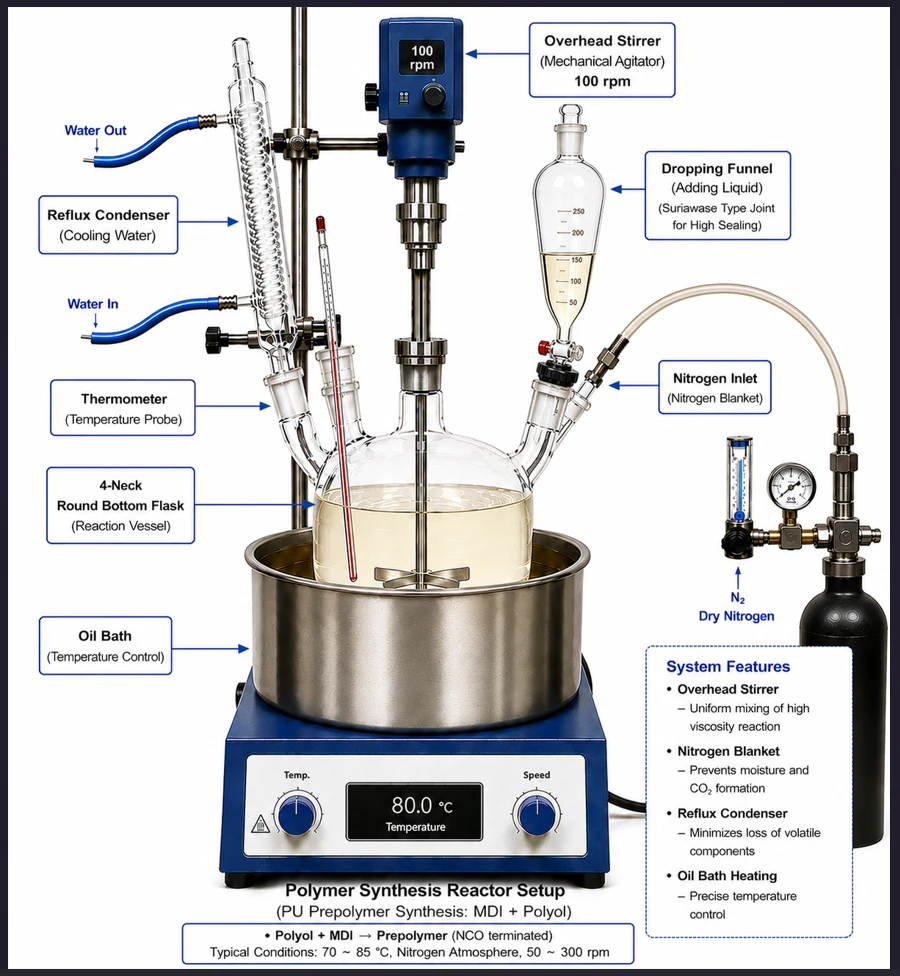
Main Equipment Configuration
• Reactor: 4-Neck Round Bottom Flask
• Overhead Stirrer (with RPM indicator)
• Reflux Condenser
• Glass Thermometer
• Nitrogen Blanket
• Oil Bath (with Temperature Controller)
How Should Raw Material Feeding and Reaction Temperature Be Controlled?
One of the most critical factors determining Prepolymer quality is the reaction condition.
Typical Reaction Conditions
• Oil Bath Temperature: 50°C–60°C
• Charge liquid Pure MDI (45°C)
• Charge PPG (25°C) while adding in 2–3 separate drops to monitor the exothermic temperature. After confirming that no MDI crystallization occurs and that the reaction temperature remains stable, the remaining PPG may be charged at once.
• Reaction Temperature: 70°C–85°C
• Reaction Time: 3–5 hours
• Cool to 40°C before packaging.
Before and after charging, the transparency of Pure MDI should always be checked. If the material appears cloudy, its use is not recommended.
PPG with a moisture content of 0.1% or higher is not suitable for use. Excess moisture may cause an increase in viscosity and increased opacity of the finished Prepolymer.
What Should Be Analyzed After Manufacturing?
The following properties are typically analyzed after the Prepolymer has been synthesized.
• Appearance (APHA)
• NCO Content (%) – to verify that the raw material charge was accurate.
• Viscosity (cPs at 25°C) – to confirm that the desired Polymer has been formed.
These analyses verify whether the designed Prepolymer has been manufactured as designed.
Why Should Pure MDI Not Be Stored at Room Temperature?
Anyone who has experience manufacturing Prepolymers has probably heard the following advice:
"Never leave Pure MDI at room temperature."
The reason is Dimer formation.
What Is a Dimer?
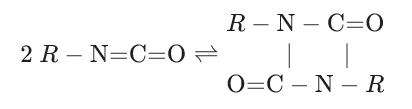
Dimer (Uretdione) Formation Mechanism
(Reaction mechanism in which two Isocyanate (-NCO) groups react with each other to form a Uretdione structure.)
A Dimer is a structure formed when two Isocyanate groups undergo a self-reaction to produce a Uretdione.
If the Dimer Content in Pure MDI exceeds 0.2% (2,000 ppm), normal use may become difficult.
Dimer formation is particularly sensitive to storage temperature.
The Most Critical Characteristic of Pure MDI
Pure MDI has a melting point (38.5°C) at which it readily solidifies.
In addition, the rate of Dimer formation increases within the room-temperature range.
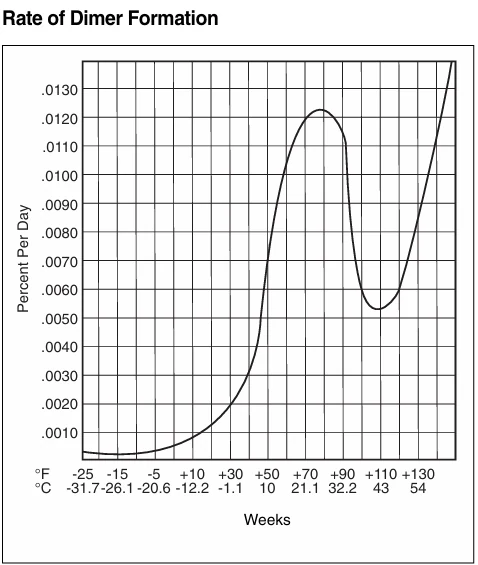
^ DOW Chemical TDS – Dimer Formation Rate
Storage of Pure MDI
Solid-State Storage
• –5°C: Can be used for 2–3 months
• –20°C: Can be used for 6 months to 1 year
Liquid Storage
• 43°C
• Can be used for 3–4 weeks
• Recommended for use within 2 weeks
(Refer to the MDI Manufacturer's TDS.)
How to Melt Solid MDI in the Laboratory
Method 1
• Melt the material as quickly as possible in a 90°C oven.
• Transfer it to a 45°C oven for storage.
• Discard the material if cloudiness is observed.
• Can be used for 2–3 weeks in a 45°C oven.
• Discard thereafter.
• Dimer Content is expected to exceed 0.2%.
Method 2
The following Modified MDI products also require careful handling.
• Cosmonate LL
• Isonate-143L
• Lupranate® MM103
Melt the material as quickly as possible in a 70°C oven, then transfer it to a 25–35°C oven for storage.
If cloudiness is observed, it is recommended to discard the material.
Solid-state storage is not recommended.
What Is the Difference Between Quasi Prepolymer and Full Prepolymer?
Quasi-Prepolymer vs Full Prepolymer
| Items | Quasi-Prepolymer | Full Prepolymer |
|---|---|---|
| Equivalent Ratio (Iso : OH) | ≥2 : 1 | 2 : 1 |
| NCO (%) | Varies depending on the Isocyanate type | 3–12 (Varies depending on the Polyol type) |
| Viscosity | Low | High |
| Solvent | Not required to slightly required | Required to slightly not required |
| Reaction & Curing Rate | Fast | Slow, aging time required |
| Mechanical Properties | Excellent hardness, elasticity, and tensile strength | Excellent softness, elasticity, and elongation |
| Main Applications | Spray Polyurea, Automotive Interior Materials, Shoe Soles | Roller-Type PU Floor Waterproofing, Synthetic Leather, TPU, Spandex |
As shown in the table above, Quasi-Prepolymer is suitable for Spray Polyurea applications that require rapid curing and high tensile strength.
In contrast, Full Prepolymer provides excellent elongation and flexibility, making it suitable for PU Floor Waterproofing, TPU, and Synthetic Leather.
Why Is Acid Added During Prepolymer Manufacturing?
Many people consider Acid to be a simple additive. However, in practice, it is an important process directly related to Storage Stability.
The main purposes are as follows.
Neutralization of Alkaline and Catalyst Components
• Neutralization of Potassium Hydroxide (KOH)
• Suppression of side reactions caused by DMC (Double Metal Cyanide)
Suppression of Chain Extension Caused by Moisture
• Prevention of viscosity increase
• Extension of storage life
However, before use, it is essential to confirm whether the Acid contains any components that may act as moisture or as a catalyst.
APTECH Polyurea & Polyurethane Technology
With more than 20 years of experience in manufacturing Polyurea Coating Systems and Polyurethane Systems, APTECH provides customized solutions.
Through continuous research and development in Polyurea Waterproofing, Protective Coatings, Urea Coating Systems, Polyurethane Foam Systems, and related raw materials, APTECH delivers more reliable and competitive products to its customers.
FAQ
PU Prepolymer & Pure MDI Handling
It is used to design the mechanical properties of the final product.
Because the rate of Dimer formation increases, which may result in deterioration of product quality.
It may affect Prepolymer manufacturing and product quality.
To prevent an increase in viscosity and increased opacity.
Quasi-Prepolymer provides fast curing, while Full Prepolymer offers superior elongation and flexibility.
To suppress gelation, viscosity increase, and side reactions.
Pure MDI is particularly susceptible to Dimer formation. Modified MDI can also experience an increase in Dimer Content if it is stored under improper conditions. Therefore, proper temperature control is essential.