Expert knowledge and insights on polyurethane technology,
waterproofing systems, and industrial chemical solutions.
Examining Catalyst Types and Functions Through Structural Formulas — Injection Rigid PU Foam – Blowing / Gelling / Trimer Catalyst
Understanding catalyst structural formulas to control Cream Time, Gel Time, blowing/gelling balance, and Demold Time in rigid PU foam

APTECH is a manufacturer that has been developing and supplying raw materials for Spray Polyurea Coating and Polyurethane Foam systems for at least 20 years. The company is well regarded for offering both products with a broad processing window and competitive specifications suited to site conditions.
In this column, we use structural formulas to provide an engaging explanation of catalysts for Injection Rigid PU Foam, which reacts more slowly than PU Spray Foam systems and is formed by injection into a mold.
For molded foam, the key is to fill the mold completely without air voids.The foam must fully fill every gap, including the complex corners of refrigerator cabinets, the ends of long Sandwich Panels produced by a discontinuous process, and the sides of Sandwich Panels produced continuously at high line speeds. To achieve this, the raw materials must have an appropriate viscosity, and mold flowability must be maximized.
The mold flowability of PU Foam is generally described in terms of three key indicators.
- The time interval between Cream Time (CT) and Gel Time (GT)
- The viscosity rise curve (Viscosity Profile)
- Blowing Power.
We will focus on the structural formulas of the relevant catalysts to provide an intuitive understanding of the principles behind each indicator and the associated process control approaches.
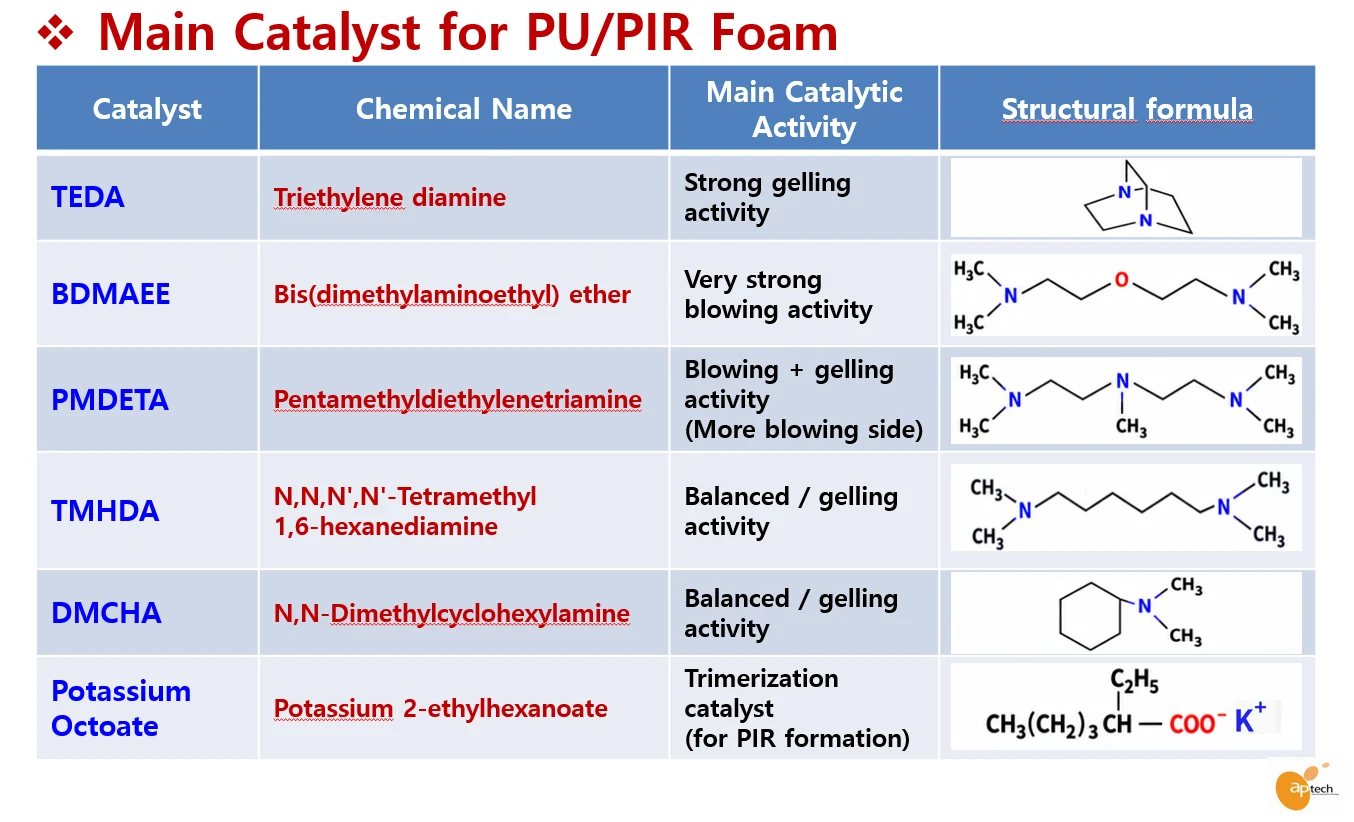
Reference: List of Catalysts Discussed in This Column
1. Mold Flowability
The CT ~ GT interval is the most important reference indicator when designing a PU reaction profile. This interval determines flowability because it represents the physical period during which the raw materials retain their fluidity and can flow freely during the PU reaction.
CT is the point at which gas is generated, expansion occurs, and a pushing force (Rise Power) develops after the Polyol system and Isocyanate are mixed.
In Flexible Foam systems, BDMAEE(NIAX A-1), which has the highest activity toward water, is the main catalyst used to control CT. In relatively fast-reacting Rigid Foam applications such as refrigerator systems, catalysts such as PMDETA(Polycat-5), which balance CT and GT, are mainly used. Depending on the required properties of the molded product, a very small amount of A-1 may be used to adjust CT.
(* Each catalyst manufacturer's trade name is also provided for ease of understanding.)
GT is the critical point at which viscosity rises sharply as polymer chains grow and the material changes from a liquid to a solid (resin), so that it can no longer flow.
To control GT, catalysts such as TMHDA(Toyocat-MR) can be used in complementary combinations with TEDA(DABCO 33-LV) or DMCHA(Polycat-8), which have stronger gelling activity. In some discontinuous Panel systems, PC-8 is used alone.
Flowability and GT as a Multiple of CT (CT : GT)
During the flow interval (CT ~ GT), gas pressure from the chemical blowing agent (H₂O) and physical blowing agents (141b, C-Pentane, HFO, etc.) in the PU Foam system pushes the liquid raw materials through the mold's complex geometry and into its corners and extremities. This flowability can be adjusted through the ratio of blowing catalysts to gelling catalysts. For example,
- For a refrigerator system with a CT of 5 seconds and a GT of 35 seconds, the ratio is 1 : 7,
- For a discontinuous Panel system with a CT of 20 seconds and a GT of 100 seconds, the ratio is 1 : 5,
- For a continuous Panel system with a CT of 15 seconds and a GT of 60 seconds, the ratio is 1 : 4.
These ratios can be used as one of the tools for matching the molding conditions at each site.
2. Catalyst Activity Mechanisms Explained Through Structural Formulas
The types of catalysts that control CT and GT and their activity mechanisms are described below.
We believe that understanding each catalyst's structural formula and activity mechanism, rather than simply using it, may be more helpful in developing PU systems and optimizing molding processes.
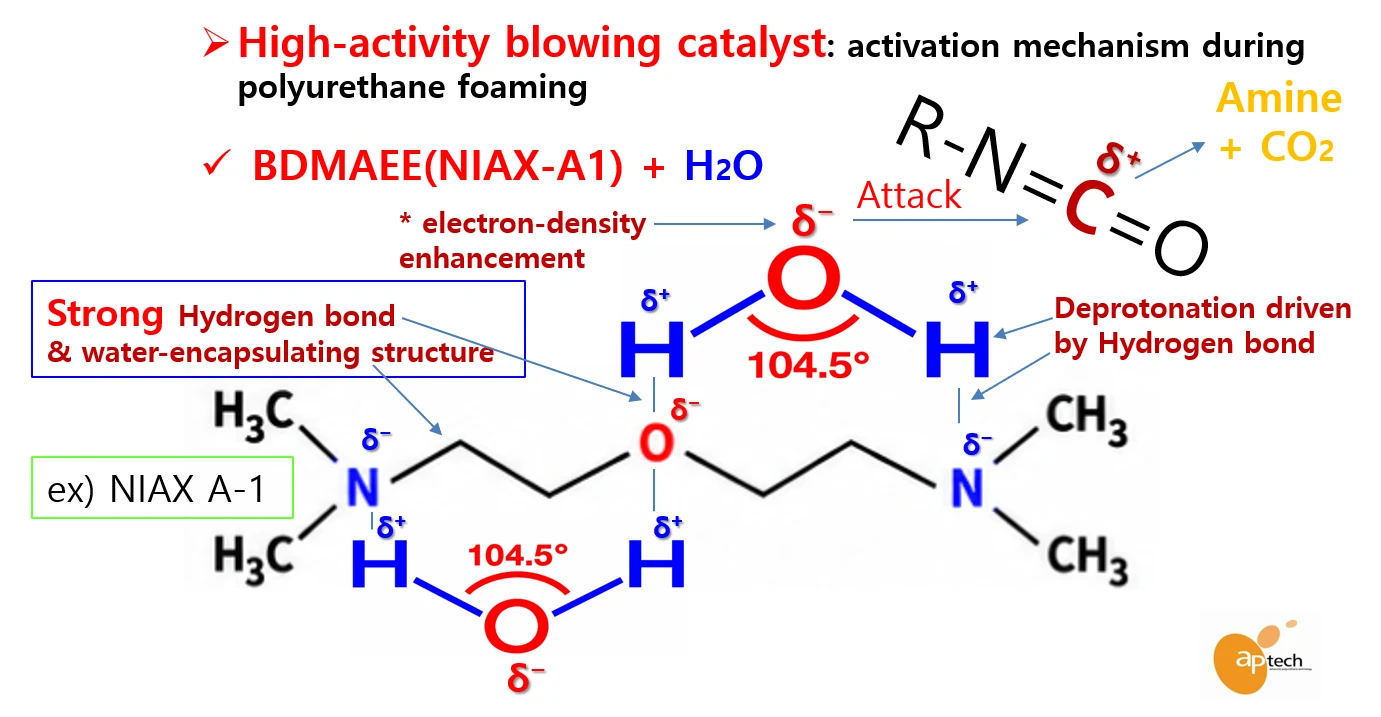
BDMAEE(NIAX A-1): A Powerful Blowing Catalyst That Targets Water (H₂O)
BDMAEE is hydrophilic, and the ether oxygen (-O-) at the center of its molecule forms a perfectly matched hydrogen-bonding arrangement with the hydrogen (-H) of the highly polar water (H₂O) molecule, which has a characteristic angle of 105°. As the structural formula below shows, its physicochemical structure holds the water molecule firmly at the center of the catalyst, forming very strong hydrogen bonds.
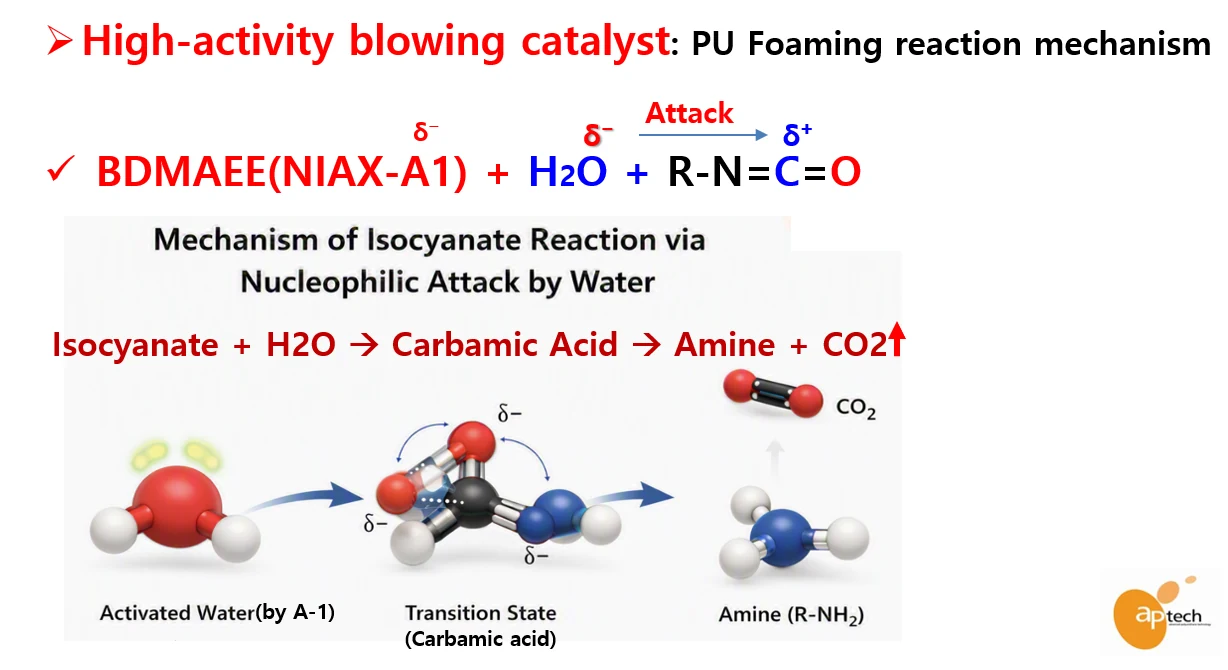
As a result, the oxygen atom in the water (H₂O) molecule is activated as a strong nucleophile, -O(δ⁻)-, with greatly increased electron density. This nucleophile attacks the central atom of Isocyanate (R–N=C=O),
-C(δ⁺)-, bonding with it to produce Amine and CO₂ gas and cause the foam to expand. The foaming rate is very rapid, approximately 1.5 times that of PC-5.
The overall reaction mechanism between Isocyanate and water (H₂O) is shown below.
The Strong Blowing Effect of PMDETA(Polycat‑5)
Although classified as a dual-function catalyst that promotes both blowing and gelling reactions, it exhibits relatively greater blowing activity in the actual reaction.
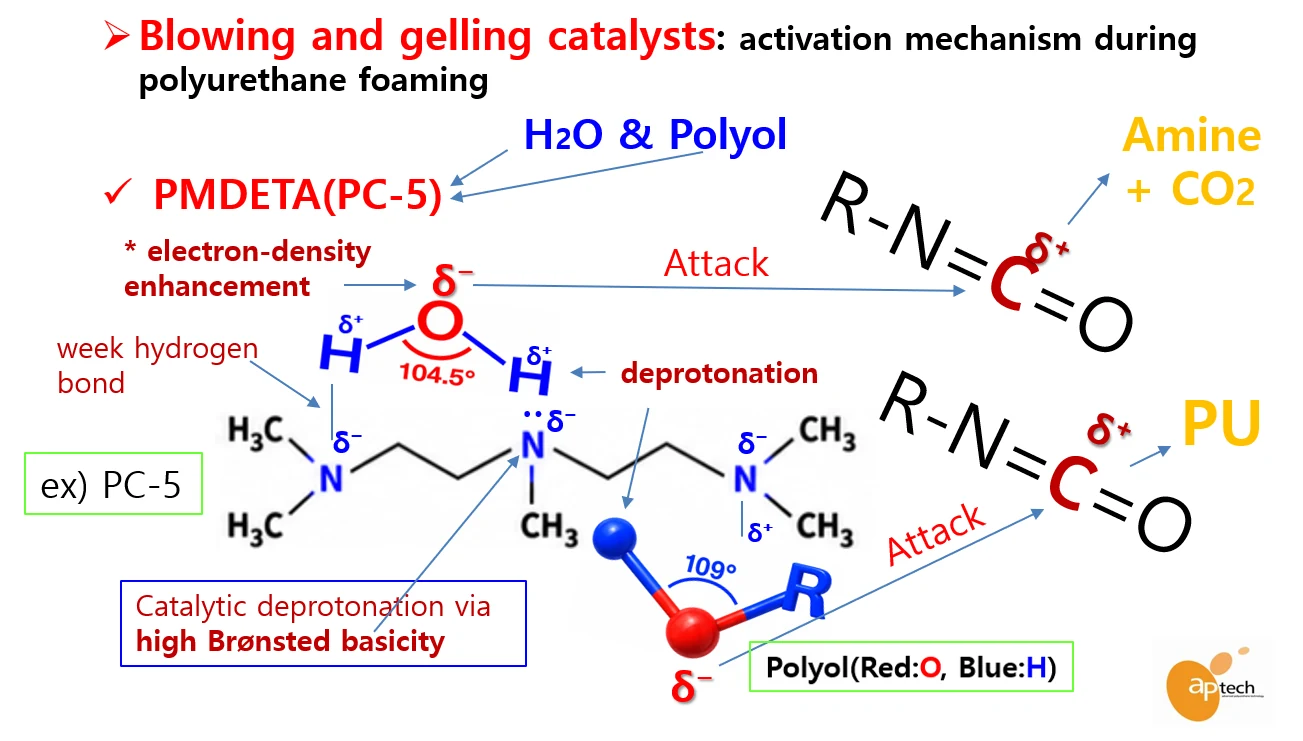
In PMDETA:
The terminal amine guides water (H₂O) toward the central amine through weak hydrogen bonding, and
The Brønsted basicity of the central amine draws hydrogen from water, deprotonating it to OH⁻. Through this dual action, H₂O reacts rapidly with NCO to generate CO₂ gas, increasing the foaming rate.
By the same principle, it also acts as a gelling catalyst by activating the –OH group of Polyol and increasing its reactivity with Isocyanate.
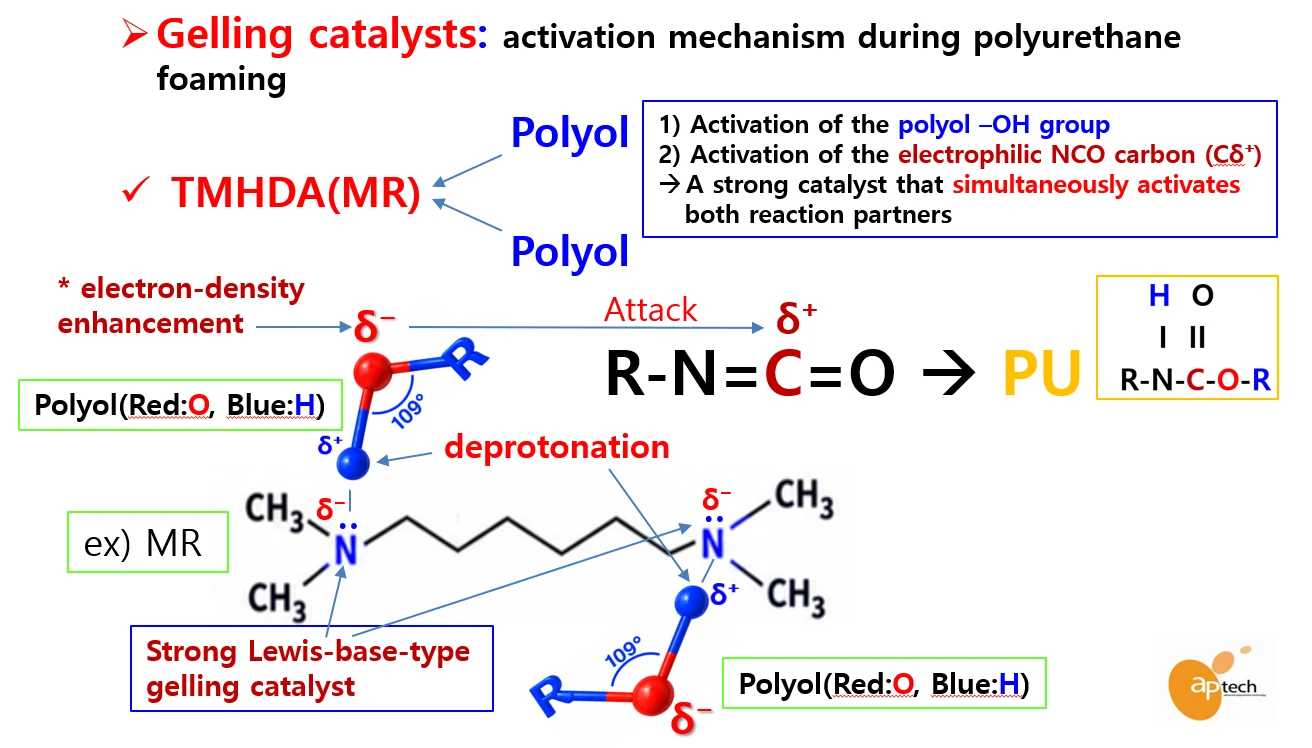
TMHDA(MR): A Powerful Gelling Catalyst That Targets Polyol
From a structural perspective, MR is similar to NIAX A-1, but its chain consists only of carbon (Hexamethylene), making it more hydrophobic. As a result, it has a stronger tendency to selectively attract Polyol rather than water.
PC-5 also has substantial steric hindrance because of the Methyl group(-CH3) on its central nitrogen (N). In contrast, MR has a nearly linear structure that allows easier access for –OH and NCO, significantly increasing the gelling reaction rate.
From an electronic perspective, the amine in TMHDA has strong Lewis base characteristics and:
- induces mild deprotonation of Polyol –OH,
- increases the electrophilicity of C(δ⁺) in NCO, and
- simultaneously activates both reactants, acting as a strong gelling catalyst that strongly promotes resin crosslinking.
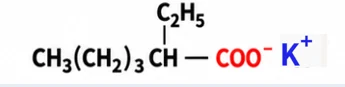
Potassium Octoate(K-15) for Shortening Demold Time (DT)
Even when the interval between CT and GT is the same, Demold Time, which is linked to the full-curing stage, can differ. This variation has an important impact on productivity.
Potassium Octoate is a PIR(Polyisocyanurate) catalyst frequently used to accelerate late-stage curing. In some cases, combining it with a strong gelling catalyst such as TEDA may produce a more pronounced synergistic effect.
We will revisit PIR catalysts in a future column.
We hope this information will be helpful in your work.
FAQ
Injection Rigid PU Foam Catalysts & Mold Flowability
For molded foam, the key is to fill the mold completely without air voids. The raw materials must have an appropriate viscosity and adequate mold flowability to ensure that the foam fills every gap, including the corners of refrigerator cabinets, the ends of Sandwich Panels produced by a discontinuous process, and the sides of Sandwich Panels produced continuously.
APTECH identifies the time interval between Cream Time (CT) and Gel Time (GT), the viscosity rise curve (Viscosity Profile), and Blowing Power as the key indicators for evaluating the mold flowability of PU Foam.
CT is the point at which gas is generated, expansion occurs, and a pushing force (Rise Power) develops after the Polyol system and Isocyanate are mixed. GT is the critical point at which viscosity rises sharply as polymer chains grow and the material changes from a liquid to a solid (resin), so that it can no longer flow.
The CT ~ GT interval is the physical period during which the raw materials retain their fluidity and can flow. The examples in this column are a refrigerator system with a CT of 5 seconds and a GT of 35 seconds, giving 1 : 7; a discontinuous Panel system with a CT of 20 seconds and a GT of 100 seconds, giving 1 : 5; and a continuous Panel system with a CT of 15 seconds and a GT of 60 seconds, giving 1 : 4. These ratios can be used as one of the tools for matching molding conditions at the site.
During the flow interval, gas pressure from the chemical blowing agent (H₂O) and physical blowing agents (141b, C-Pentane, HFO, etc.) pushes the liquid raw materials. APTECH explains that flowability can be controlled through the ratio of blowing catalysts to gelling catalysts. It describes BDMAEE(NIAX A-1) as a strong blowing catalyst; PMDETA(Polycat-5) as a catalyst that promotes both blowing and gelling, with relatively greater blowing activity; and TMHDA(Toyocat-MR) as a strong gelling catalyst.
Even when the interval between CT and GT is the same, Demold Time, which is linked to the full-curing stage, can differ. APTECH describes Potassium Octoate as a PIR(Polyisocyanurate) catalyst that accelerates late-stage curing and advises that it can be used with TEDA in some cases.
CT, GT, the viscosity rise curve, Blowing Power, and the catalyst combination must be considered together according to the molding conditions and required properties. APTECH is a manufacturer that has been developing and supplying raw materials for Spray Polyurea Coating and Polyurethane Foam systems for at least 20 years. Please contact APTECH about the relevant raw materials and specifications suited to your site conditions.