Expert knowledge and insights on polyurethane technology,
waterproofing systems, and industrial chemical solutions.
Why Has Polyurea Waterproofing Become the Industry Standard?
Evolution of Waterproofing Materials and Criteria for Selecting High-Performance Coating Systems
Importance of Waterproofing — Why Has It Become More Critical in Industrial Structures?
In industrial facilities and building structures, waterproofing is no longer a simple maintenance task. It is a critical factor that directly affects structural lifespan, safety, and maintenance costs.
Recently, search keywords such as "Polyurea waterproofing," "industrial waterproof coating," and "Polyurea coating advantages" have been rapidly increasing. This trend reflects the limitations of traditional waterproofing systems and growing market demand for high-performance waterproofing technologies.
In particular, industrial waterproofing, roof waterproofing, and parking deck protection now require system-based waterproofing solutions that simultaneously provide long-term durability and efficient application.
Why Did Traditional Waterproofing Materials Repeatedly Fail?
Historically, asphalt sheet waterproofing functioned by attaching a barrier layer to block water. However:
• High-temperature environments → Softening occurred
• Low-temperature environments → Cracking occurred
Due to these characteristics, long-term durability was limited in environments with significant temperature variation.
Later, epoxy and polyurethane (PU) liquid-applied membranes introduced adhesion-based waterproofing to the substrate. However:
• Slow curing time
• Sensitivity to humidity and temperature conditions
These factors caused recurring issues in industrial environments, particularly regarding application stability and long-term performance.
New Waterproofing Standards Required by Industrial Environments
Modern industrial facilities, parking structures, plants, and logistics centers require the following performance simultaneously:
• Fast curing speed
• High elongation, tensile strength, and elasticity
• Resistance to repetitive mechanical loads
• Chemical and moisture resistance
• Seamless waterproof membrane structure
Traditional waterproofing systems struggled to meet all these complex performance requirements.
Why Polyurea Coating Systems Became the Standard Technology
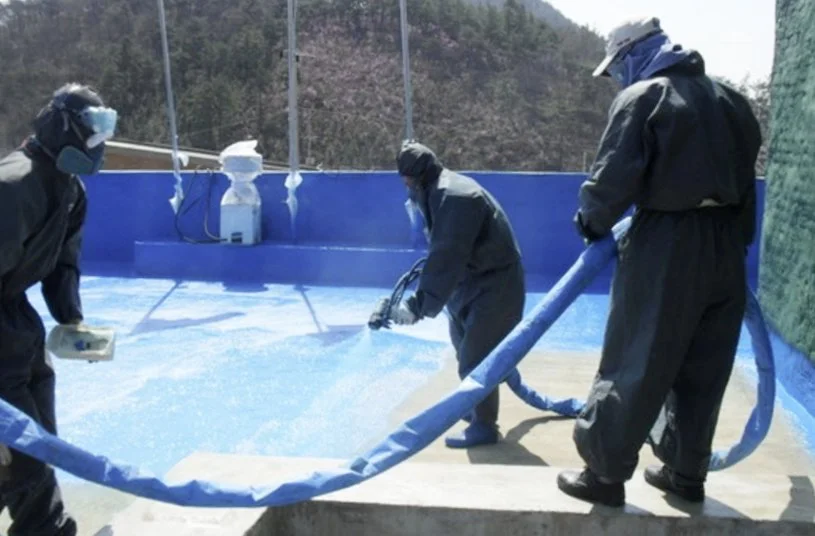
Spray Polyurea systems use high-pressure spray application to form a seamless, monolithic waterproof membrane on the substrate surface.
This enables simultaneous achievement of:
• Ultra-fast curing (within seconds to tens of seconds)
• Adaptability to complex geometries
• High abrasion and impact resistance
• Long-term durability
Because of these characteristics, Polyurea coatings have become the industry standard technology for industrial waterproofing and high-performance flooring systems.
Field Application Case — APTECH Spray Polyurea System
To meet demanding industrial performance requirements, the following products based on the APTECH Polyurea System are widely applied:
These systems are designed to deliver stable performance in:
• Parking deck floors
• Roof waterproofing areas
• Industrial facility and plant flooring environments
Even under repetitive load and moisture exposure, the system aims to provide both long-term protection and application stability.
Conclusion — Criteria for Selecting a Waterproofing System
Selecting a waterproofing system should not be based solely on price comparison. Instead, decisions should be made based on technical criteria, including:
• Site environmental conditions
• Required performance level
• Long-term maintenance cost
Spray Polyurea systems have established themselves as a high-performance waterproofing solution that meets modern industrial performance standards.
FAQ
Frequently Asked Questions
Polyurea features ultra-fast curing and high elongation and tensile strength. Its seamless monolithic membrane structure provides superior durability and application efficiency in industrial environments. High-performance systems such as APTECH UA-1001 Pure Polyurea are commonly used for high-load and high-humidity conditions.
EPL-550 is a cost-efficient hybrid Polyurea-based waterproofing system optimized for roofs and parking decks. PK-410 is a hybrid coating with properties similar to pure Polyurea and is primarily used in industrial flooring environments where abrasion resistance and mechanical durability are required.
It is ideal for roofs, parking structures, industrial facilities, and plant equipment areas exposed to repetitive loads, slopes, and complex geometries. In such environments, APTECH Polyurea System products — UA-1001, EPL-550, and PK-410 — are selected based on site conditions.
Due to fast curing and high durability, repair cycles are extended and reapplication frequency is reduced, resulting in lower long-term maintenance costs.