Expert knowledge and insights on polyurethane technology,
waterproofing systems, and industrial chemical solutions.
Effects of Application Conditions on Polyurea (Urea Coating) Waterproofing — Preventing Air Bags and Coating Delamination Under High-Humidity and Low-Temperature Conditions
Material selection, surface preparation, dew point management, and condensation control for reliable polyurea waterproofing

APTECH is a manufacturer with over 20 years of experience in developing and supplying raw materials for Spray Polyurea Coating and Polyurethane Foam Systems. In addition to providing products suitable for a wide range of application environments, APTECH has earned a strong reputation for proposing competitive specifications tailored to specific site conditions.
In the previous column, titled “Factors Determining the Durability of Urea Coating Waterproofing Materials – Materials, Design, and Application Management,” we examined the key performance criteria required to meet KS F 4922 (Polyurea Resin Waterproofing Membrane Coating), a Korean standard that is particularly difficult to satisfy in terms of material performance.
In this column, we will examine the application environment and management conditions that determine the quality of polyurea waterproofing installation. In particular, we will focus on the causes of Air Bag formation and coating delamination that may occur under high-humidity conditions in summer and dew point conditions during seasonal transitions, as well as system design and application management methods for preventing these issues.
Why Air Bags and Coating Delamination Matter in Polyurea Waterproofing
In construction, not only waterproofing performance and durability but also appearance after application are important quality factors.
For example, if a wave effect appears on the exterior walls of a sandwich panel building after installation, the building owner may request replacement or reinstallation due to appearance issues.
The same applies to Spray Polyurea waterproofing. Air Bags or coating delamination after application can affect not only appearance but also the long-term adhesion and durability of the waterproofing layer.
A typical example is a slab rooftop waterproofed with a two-component, manually applied PU waterproofing material. The surface may remain flat immediately after application or before exposure to direct sunlight, but Air Bags may develop in multiple areas after sunlight exposure.
These issues can result from a combination of factors, including substrate moisture, atmospheric humidity, dew point, application temperature, and waterproofing system design. Therefore, site conditions should be carefully reviewed before application.
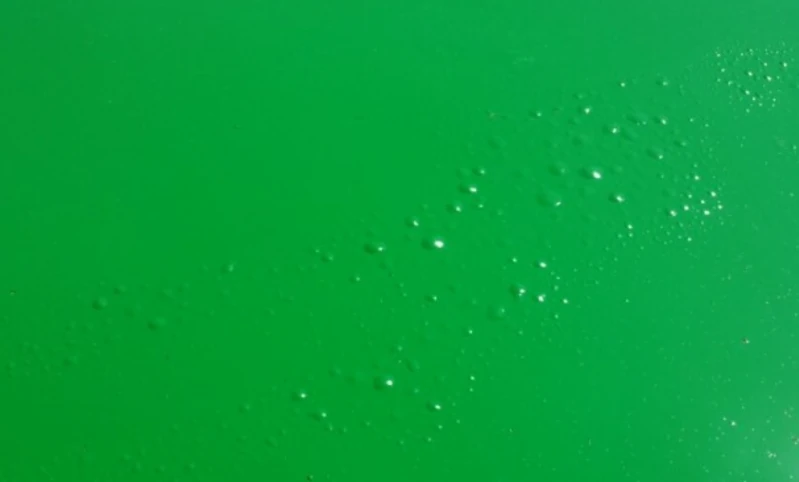
▲ Example of Air Bag Formation in Polyurea Waterproofing
This can occur when the raw material is not suitable for hot and humid summer conditions, or when poor substrate preparation results in insufficient adhesion between the substrate and the waterproofing material. Moisture remaining in the concrete can also be affected by high temperatures, pushing up areas with weak adhesion and causing Air Bags (blisters) and coating delamination.
So, why do Air Bags occur in Spray Polyurea waterproofing, and what conditions should be considered to prevent them?
A. Causes and Countermeasures for Polyurea Air Bags in High-Humidity Conditions
Air Bag formation during Spray Polyurea waterproofing can generally be attributed to two main causes: the use of Hybrid Polyurea that has not been sufficiently verified through four-season or international field testing, and inadequate substrate preparation.
1. Raw Material – Differences in Moisture Reaction Between Pure Polyurea and Hybrid Polyurea
Pure Polyurea provides optimal performance. However, where cost efficiency is required, it is important to select a proven Hybrid Polyurea System with minimal Air Bag formation, similar to Pure Polyurea, even under high-humidity conditions.
APTECH’s Hybrid Polyurea Waterproofing System, with over 20 years of history, has been proven across Korea’s four seasons and in the Middle East, Southeast Asia, China, and Europe, offering a wide range of applications.
Hybrid Polyurea was developed to overcome the high cost of Pure Polyurea, which can limit its use from the design stage. Although Hybrid Polyurea has sometimes been avoided due to more frequent Air Bag formation than Pure Polyurea, APTECH’s Hybrid Polyurea products have demonstrated excellent performance at various sites over many years and are highly regarded for their application performance.
Why, then, are Air Bags more common with Hybrid Polyurea? Excluding abnormal Spray Machine operation, we will focus only on its relationship with water.
Spray Polyurea is an A/B Two-Component System. Component A is Isocyanate, while Component B is a Polyamine or PPG (Polyol) System.
Air Bags mainly occur due to CO₂ gas generated when the Isocyanate in Component A reacts with water. This is a key challenge for Hybrid Polyurea.
Polyamine, the main raw material in Pure Polyurea, reacts faster than water but is expensive. In contrast, PPG (Polyol), used in Hybrid Polyurea, is less expensive than Polyamine but reacts more slowly than water, which can cause Air Bags.
To overcome this issue, various Catalysts and Additives are used in Hybrid Polyurea. However, achieving the same reactivity as a Pure Polyurea System remains difficult.
Therefore, Hybrid Polyurea products require actual field verification throughout all four seasons. Products such as APTECH’s Hybrid Polyurea EPL-550, with four-season verification and extensive application records in international markets, are therefore especially important.
Key Isocyanate Reactions and Reaction Characteristics of Hybrid Polyurea
To understand why Air Bags may occur in Hybrid Polyurea under high-humidity conditions, it is necessary to first examine how Isocyanate reacts with Polyol, water (H₂O), and Amine.
1. Isocyanate + Polyol → Urethane

2. Isocyanate + H₂O → Carbamic Acid → Amine + CO₂

3. Isocyanate + Amine → Urea

Differences in Reaction Rate Without Catalysts
The differences in reaction rate and the potential for CO₂ generation at different temperatures are compared below.
This table shows how technically challenging it is to use Polyol in a Spray Polyurea System.
When Polyol is used, catalysts are essential, but simply adding a catalyst is not enough. Precise catalyst formulation and advanced system design are required to prevent Air Bag formation.
By comparing these reaction rates, the table below clearly shows the level of precision required in A/B component formulation for a Hybrid Polyurea System.
| Temperature | Water H₂O (Reference) | Primary Hydroxyl Group R-OH | Primary Aromatic Amine R-NH₂ | Physical/Chemical Behavior During Field Application |
|---|---|---|---|---|
| 5°C (Winter) | 1 | 0.05–0.1 | 40–60 | Urethane (R-OH): The reaction is nearly stopped, resulting in slow coating curing and continuous CO₂ generation. Urea (Amine): Amine reacts dozens of times faster than water even without a catalyst, fundamentally preventing moisture reaction. |
| 20°C (Spring/Fall) | 1 | 0.2–0.5 | 20–30 | Standard reference temperature in polymer science. Urethane (R-OH): The reaction remains slow, increasing the risk of Air Bag defects. Urea (Amine): Rapid reaction enables stable curing. |
| 60°C (Summer) | 1 | 0.8–1.2 | 5–15 | Urethane (R-OH): As temperature rises, molecular motion increases and the relative reaction-rate gap narrows. However, the absolute reaction rate of water also increases, causing a rapid increase in CO₂ gas and Air Bag formation immediately after spraying. Urea (Amine): Reacts faster than water, fundamentally preventing moisture reaction. |
2. Application
Air Bag formation can generally be attributed to inadequate concrete surface grinding, improper Primer application, and the absence of Air Vents. Depending on site conditions, the installation of Air Vents may be particularly important.
1) Inadequate Grinding of the Concrete Surface
The main purposes of grinding, which can determine the success of waterproofing work, are as follows.
① Removing Delaminated Areas If delaminated areas are not removed, trapped air can expand under intense solar heat, pushing up the coating and causing Air Bags.
② Improving Adhesion Existing aged waterproofing materials, laitance (a powdery cement surface layer), oil, and other contaminants should be removed so that the waterproofing material can bond directly to the concrete. Air Bags are more likely to occur in areas with poor adhesion.
③ Surface Leveling Severe unevenness and protrusions should be ground down to create a flat surface and ensure a uniform Dry Film Thickness (DFT). Air Bags are more likely to occur where the coating is too thin.
2) Improper Primer Application
If the Primer is applied too thinly, the micro-pores in the concrete may not be fully sealed. During Polyurea application, trapped air can escape and form Air Bags, or expand under intense solar heat and push up the coating.
3) Absence of Air Vents
At sites where water may remain in the insulation layer of an old concrete rooftop, or where water and moisture are likely to persist beneath an underground parking floor, Air Vents should be installed at appropriate intervals to release internal moisture and gas pressure.
Especially on rooftops, moisture inside the concrete can expand by approximately 1,700 times under intense solar heat. Without Air Vents, this pressure can cause Air Bags and, in severe cases, tear the coating.
B. Preventing Air Bags and Coating Delamination Caused by Dew Condensation on Low-Temperature Structure Surfaces
When applying Spray Polyurea waterproofing under high-humidity conditions from spring to summer, the risk of Air Bags and coating delamination must be carefully considered, as these defects can result from condensation on the substrate during application.
Dew Condensation refers to moisture condensing on the substrate surface, while the critical temperature at which condensation begins is called the Dew Point.
Applying waterproofing to a substrate below the Dew Point is similar to applying a waterproofing material over water.
As an extreme example, some YouTube videos show Polyurea being sprayed onto ice and curing immediately without foaming. However, this only demonstrates the excellent low-temperature curing properties of Polyurea; adhesion to the substrate is not achieved.
In fact, during the early commercialization of Spray Polyurea, there were cases at large-scale sites where coatings applied to cold structural surfaces in winter became completely delaminated as the weather warmed after spring.
Relationship Between Substrate Temperature and Dew Point in Polyurea Application
Based on field experience, Spray Polyurea application is generally considered safe when the substrate temperature is at least 3°C above the Dew Point.
Therefore, before Polyurea waterproofing, it is important to check not only the air temperature but also the Dew Point based on the ambient temperature and Relative Humidity, and compare it with the actual substrate surface temperature.
The Dew Point is determined by air temperature and Relative Humidity and can be calculated using the Magnus Formula for Dew Point.
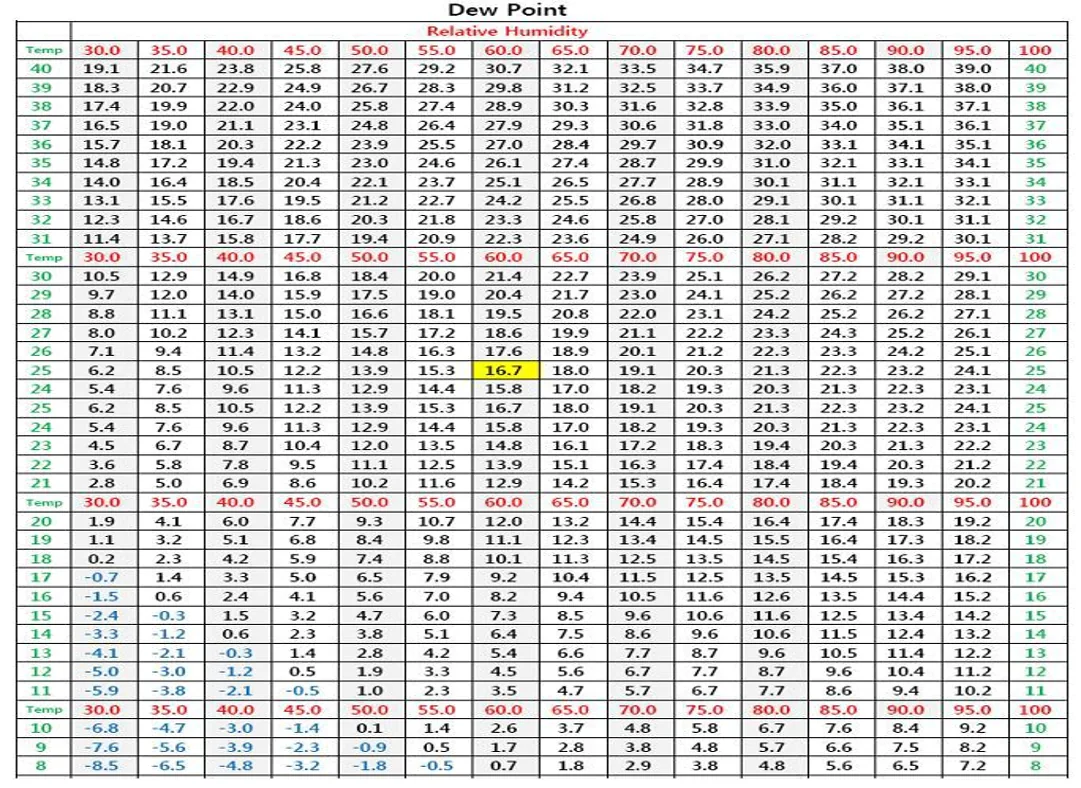
For example, as shown in the yellow area of the table below, when the air temperature is 25°C and the Relative Humidity is 60%, the Dew Point is 16.7°C.
Under these conditions, a substrate temperature of approximately 19.7°C or higher—at least 3°C above the Dew Point of 16.7°C—is considered safe for Spray Polyurea application.
[Dew Point Temperature Table]
To accurately determine whether condensation is present on the substrate, the substrate temperature should be measured directly. However, the graph below provides a simple example to help explain the relationship between the Dew Point and Dew Condensation.
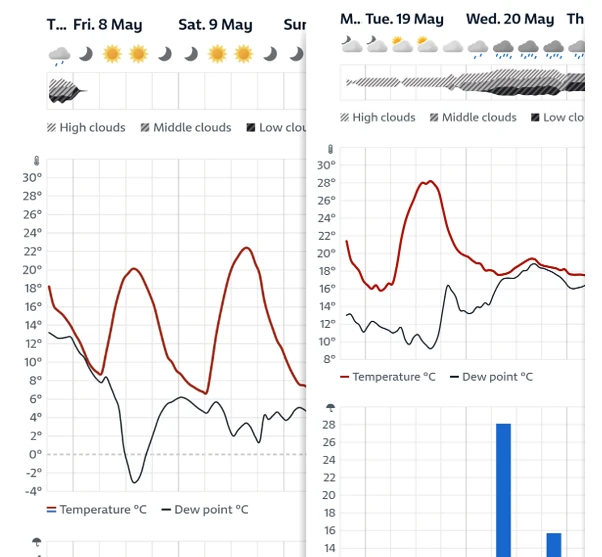
In the graph, the black line represents the Dew Point and the red line represents the air temperature. Based on this comparison, the likelihood of condensation on the substrate appears relatively high on May 7 and May 20.
Therefore, Spray Polyurea application should not be determined by air temperature alone. It is important to check both the Dew Point and the actual substrate temperature to assess the risk of condensation before application.
For reference, the image below is based on data from the Norwegian Broadcasting Corporation and the Norwegian Meteorological Institute.
C. Examples of Condensation Control Methods Under Low-Temperature Conditions
Condensation occurs frequently, especially during seasonal transitions. For example, around May and June, when spring transitions into summer, indoor structures may still retain cold temperatures from winter, resulting in surface temperatures significantly lower than the air temperature.
In particular, underground structures may show an even greater difference between air and surface temperatures, and condensation is more likely when atmospheric humidity is high after rainfall.
1. Main Causes of Frequent Condensation in Underground Parking Areas
Air temperature alone does not easily raise the temperature of cold structures, so floors and walls can remain at low temperatures.
When humid outdoor air enters the underground space and moisture accumulates due to insufficient ventilation, Relative Humidity can rise above 70%, significantly increasing condensation.
Therefore, when applying Spray Polyurea waterproofing in low-temperature, high-humidity environments such as underground parking areas, it is important to check not only air temperature and Relative Humidity but also the actual substrate temperature and Dew Point.
2. Methods for Preventing Condensation
The key to preventing condensation is to keep the substrate temperature at least 3°C above the Dew Point. This can be achieved through ventilation, dehumidification, and hot-air heating.
1) Condensation Control in Multi-Level Underground Spaces
For multi-level underground spaces, the most effective way to raise the floor temperature of the application level is to treat both the application level and the floor below.
B2 Level: Provides a Backup Heat Source by heating and maintaining the temperature of the slab.
B1 Level: Directly controls air and floor temperatures using blowers, dehumidifiers, and hot-air heaters.
2) Other General Condensation Control Methods
Blowers: One of the fastest and most effective methods.
Hot-air heaters: Effectively raise the floor temperature.
Continuous dehumidifier operation: Using dehumidifiers together with blowers provides the most stable conditions.
Ventilation when outdoor humidity is low: Ventilate only when outdoor humidity is lower than indoor humidity. High outdoor humidity can further cool the floor and increase condensation.
Summer: Humidity is generally lowest between 6–10 a.m.
Winter: Daytime is relatively dry.
As described above, preventing Air Bags and coating delamination in Polyurea waterproofing requires comprehensive control of actual application conditions—including temperature, humidity, Dew Point, and substrate condition—as well as proper material performance.
We hope this information will help our customers select and apply Spray Polyurea waterproofing materials more reliably.
FAQ
Polyurea Waterproofing Under High-Humidity & Low-Temperature Conditions
Under high-temperature and high-humidity conditions, it is important to select a Polyurea System with stable reactivity that has been sufficiently proven under various climatic conditions, considering the potential for CO₂ generation from the reaction between moisture and Isocyanate. APTECH has developed and manufactured Polyurea Systems for over 20 years and has supplied products not only across Korea’s four seasons but also in the Middle East, Southeast Asia, China, and Europe. In particular, APTECH EPL-550 Hybrid Polyurea System has been applied under various site conditions for many years and is designed for stable application under high-humidity conditions and a wide range of applications.
Pure Polyurea provides fast reactivity and excellent physical properties, while actual projects must also consider cost efficiency along with required performance. For this reason, Hybrid Polyurea Systems are widely used in waterproofing and coating applications where cost efficiency is required. APTECH manufactures both Pure Polyurea and Hybrid Polyurea Systems, allowing the appropriate system to be selected according to required properties, application conditions, and cost efficiency. When using Hybrid Polyurea under high-humidity conditions, it is especially important to verify that the product has been sufficiently proven under four-season application conditions, rather than comparing price alone.
Concrete contains micro-pores. If Primer is not sufficiently applied, air and moisture within the concrete can affect the Polyurea coating, causing Air Bags or coating delamination. Therefore, a Polyurea waterproofing system requires not only a suitable topcoat but also a Primer that provides proper substrate adhesion and effectively treats micro-pores. APTECH supplies NK Safety Primer for use with its Polyurea Coating Systems and recommends system configurations based on site conditions and substrate conditions.
Underground parking areas and low-temperature structures are prone to condensation due to low substrate temperatures and high humidity. Therefore, it is important to manage not only Polyurea performance but also the Dew Point, substrate temperature, Relative Humidity, and substrate condition. APTECH manufactures Polyurea Systems for various waterproofing and industrial applications and recommends suitable products and specifications based on site conditions. Before application, the substrate temperature should be at least 3°C above the Dew Point. If necessary, blowers, dehumidifiers, or hot-air heaters should be used to ensure proper application conditions.
APTECH is a specialized manufacturer with over 20 years of experience in developing and manufacturing raw materials for Spray Polyurea Coating and Polyurethane Systems. The APTECH Polyurea Waterproofing System includes Pure Polyurea, Hybrid Polyurea, Primers, and other products required for field application. Beyond supplying raw materials, APTECH recommends suitable products and competitive system specifications based on application conditions, required properties, and application areas. With application experience across Korea’s four seasons as well as the Middle East, Southeast Asia, China, and Europe, APTECH provides Polyurea Systems suitable for a wide range of site conditions.