Expert knowledge and insights on polyurethane technology,
waterproofing systems, and industrial chemical solutions.
APTECH PM-21 Steel Primer: 2K PU Anti-Corrosive Primer for Polyurea Coating on Steel
Steel Adhesion Technology and Anti-Corrosive Primer for Polyurea Coating
VAGH Terpolymer (Wetting / Anchoring) + MDI (High Shear Strength) Design

AP Tech. has been manufacturing Spray PU Foam and Polyurea Coating systems for more than 20 years, earning recognition not only for its wide product portfolio but also for providing competitive specifications tailored to field conditions.
This Urea Coating system is widely used for Polyurea Waterproofing, Polyurea Flooring, Polyurea Anti-Corrosion Coating, and EPS Hard-Coating applications.
In this issue, we introduce PM-21 Primer, which is designed to become almost one body with steel substrates. Its primary application is as an Anti-Corrosive Primer for Steel Plates, and it is also suitable for Outdoor Steel Deck Parking Lots.
The fundamental performance of any coating system depends on adhesion to the substrate. Strong adhesion leads to improved durability and corrosion resistance. In particular, a primer must provide adhesion to both the substrate and the main coating system. PM-21 is specifically designed to maximize adhesion to steel surfaces while simultaneously forming an integrated bond with the Urea Coating system.
Adhesion is a critical factor that determines the durability of not only Polyurethane Systems but also all Coating Systems. Adhesion is the foundation of coating performance, and Spray PU Foam also relies heavily on proper adhesion. Insufficient adhesion may result in coating delamination, airbag formation, cracks, and detachment.
Following the previous issue on NK Safety Primer, an Anti-Pinhole Primer for concrete substrates, this issue introduces PM-21 Primer, which is designed to provide exceptional adhesion to steel substrates.
A. Specification
→ Steel Surface Preparation / PM-21 / Polyurea Coating / Top Coat
B. PM-21 Properties and Application Method
1. Properties
| Component | A | B (Color) |
|---|---|---|
| Viscosity cps / 25°C | 30 | 1500 |
| SP.GR / 25°C | 1.027 | 1.140 |
| Solid Content (%) | 54 | 48 |
| Appearance | Brown liquid | Gray colored liquid |
| Mixing Ratio (w/w) | 1 | 2 |
| Mix Viscosity (25°C) | 300 | 300 |
| Pot life (hrs) (20°C) | 1 | 1 |
2. Mixing
Mix Components A and B thoroughly in a mixing container for approximately 2 minutes before Roller application or Spray application.
3. Primer Consumption
0.2~0.3 Kg/m²
4. Cure Time
3~6 hours (depending on temperature)
| Item | 5°C | 20°C | 30°C |
|---|---|---|---|
| TFT (min) | 60 | 40 | 20 |
| Cure (hrs) | 6 | 4 | 3 |
5. Polyurea Application Timing
Apply Polyurea Spray within 24 hours after the Cure Time of PM-21.
6. Steel Surface Preparation
Abrasive Blasting and removal of dust, oil contamination, moisture, and other contaminants.
→ Refer to the TDS for detailed information.
C. Specialized Adhesion Theory of PM-21
1. Use of VAGH Resin
1) VAGH: Vinyl Chloride / Vinyl Acetate / Hydroxypropyl Acrylate Terpolymer
2) This hybrid vinyl resin combines the toughness and chemical resistance of Vinyl Chloride, the wetting characteristics of Vinyl Acetate, and the crosslinking reactivity of Hydroxypropyl Acrylate.
2. Function of Each VAGH Block
| Abbreviation | V | A | GH (Group Hydroxyl) |
|---|---|---|---|
| Block | Vinyl Chloride | Vinyl Acetate | Hydroxypropyl Acrylate |
| Role | Hard, Chemical Resistance | Soft, Compatibility | PU Crosslinking, Adhesion Enhancement |
| Function | Backbone of PU Adhesive | Provides Wetting | Anchoring Effect |
3. Detailed Description of Each VAGH Block
1) V (Vinyl Chloride)
Provides excellent film strength, chemical resistance, flame resistance, and durability.
• Structure Formula: CH₂=CH–Cl
• Vinyl Group: CH₂=CH–
• Chlorine Substituent: –Cl
Function
The Vinyl Chloride block accounts for approximately 80~85% of VAGH and serves as the backbone of the final PU adhesive. It helps prevent adhesive failure when significant physical forces are applied after curing.
Its highly dense molecular structure also acts as a barrier against water, oxygen, acids, and alkalis, contributing significantly to corrosion protection and long-term adhesion durability.
2) A (Vinyl Acetate)
Maximizes wetting efficiency on the substrate surface.
• Structure Formula: CH₂=CH–O–C(=O)–CH₃
• Vinyl Group: CH₂=CH–
• Acetyl Group: –C(=O)–CH₃
• The two parts are connected through an Ester Bond (O–C=O).
Function
It increases Free Volume within the resin structure and functions as an Internal Plasticizer, improving Wetting characteristics.
→ Wetting performance is maximized when mixed with solvents or Isocyanates.
→ Superior Wetting allows the resin to penetrate fine pores in steel substrates, maximizing the contact area and resulting adhesion.
3) GH (HPA: Hydroxypropyl Acrylate)
Improves adhesion through the Anchoring Effect.
• Structure Formula: CH₂=CH–C(=O)–O–CH₂–CH(OH)–CH₃
• Acrylate Portion: CH₂=CH–C(=O)–O–
• Hydroxypropyl Portion: –CH₂–CH(OH)–CH₃
When Isocyanate reacts:
Function: Adhesion enhancement through the Anchoring Effect
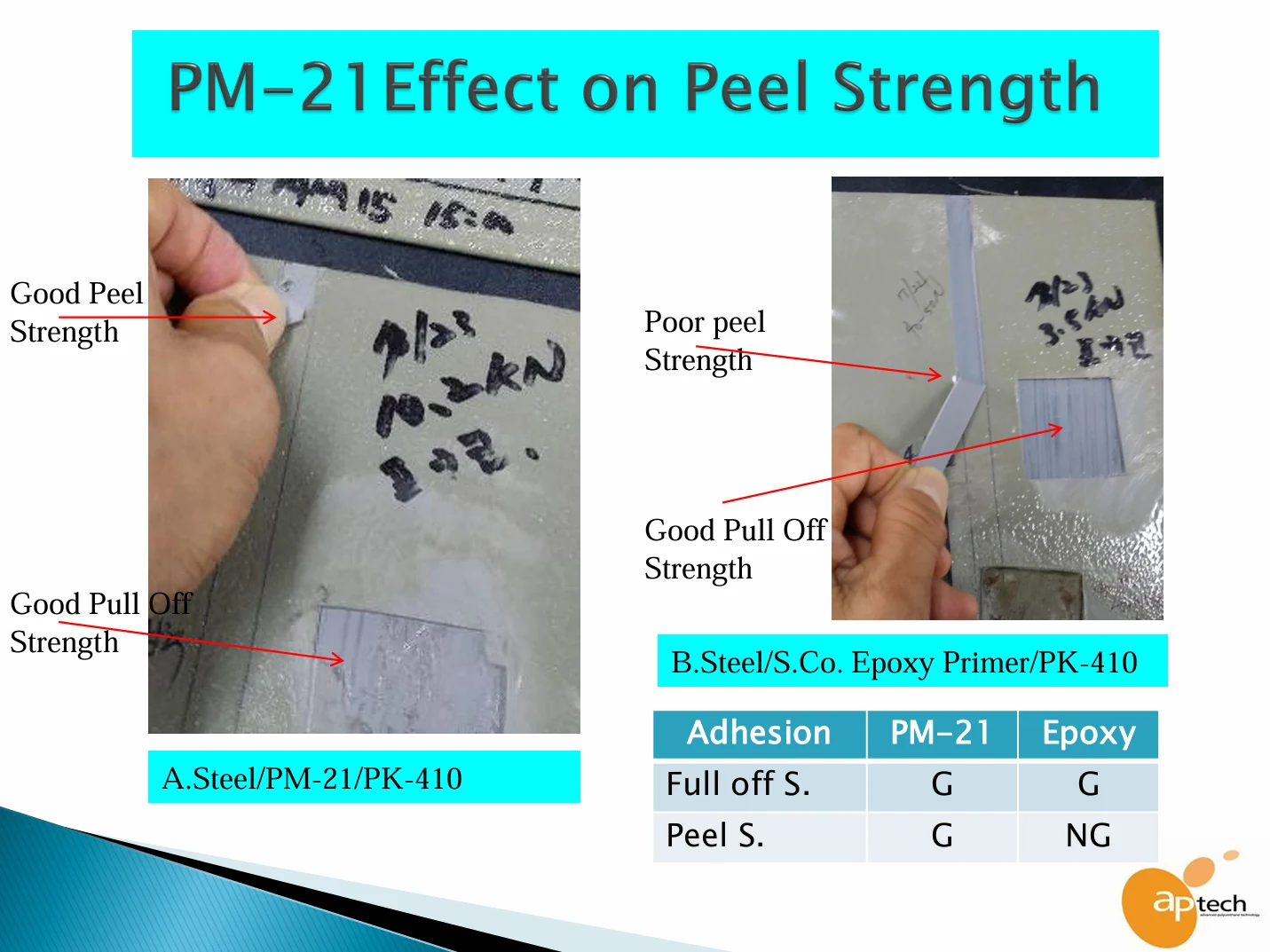
a. Due to the superior Wetting performance of Vinyl Acetate, the resin penetrates deeply into microscopic pores of the steel substrate. When PU bonding occurs in this condition, an Anchoring Effect is created, resulting in excellent adhesion and an integrated bond with the steel substrate.
b. Differences in Anchoring Effect depending on resin structure
VAGH System
VAGH is rigid and exhibits very high cohesive strength after curing. When it penetrates Abrasive Blasted steel profiles and crosslinks with MDI, it acts as a strong and stable anchor, maximizing the Anchoring Effect.
PPG System
PPG-based adhesives are flexible and penetrate well due to good Wetting performance. However, after curing they remain relatively soft. Under tensile force, the anchor itself may deform and be pulled out more easily, resulting in lower anchoring support compared to VAGH.
^ Test of Peel Strength and Pull-off Strength
4. Terpolymer
VAGH exhibits outstanding adhesion to steel because the three monomers contribute durability, wetting characteristics, and adhesion performance simultaneously, creating a synergistic effect.
5. Use of MDI: High Shear Strength
Why MDI is essential for Outdoor Steel Deck Parking Lot systems
1) Load Resistance (High Shear Strength)
When vehicles brake suddenly or turn, significant horizontal Shear Forces are applied to the adhesive layer. The rigid benzene-ring structure of MDI helps resist this movement.
2) Fast Curing (Workability)
Reducing construction time is critical for parking structures. MDI reacts quickly, allowing faster curing and earlier reopening to traffic.
3) High-Temperature Resistance (Durability)
Steel surfaces exposed to direct sunlight can reach temperatures of 60~70°C during summer. HDI tends to soften under these conditions, whereas MDI maintains adhesion due to its higher Glass Transition Temperature (Tg).
D. Key Advantages of PM-21 Primer
1. As a 2K PU Primer utilizing VAGH and MDI, PM-21 provides a synergy of chemical and physical adhesion, acting as a bridge between Steel Plates and Urea Coating systems.
2. For indoor applications, excellent adhesion can still be achieved even when coating is applied the following day. Unlike conventional 2K PU Primers or Epoxy Primers, there is no strict requirement to apply Polyurea within 24 hours after primer application. If the surface has not been exposed to dust or moisture, excellent adhesion can still be achieved the next day.
3. Virtually no pinholes occur, resulting in an improved surface appearance.
4. Proper surface preparation, including Abrasive Blasting and removal of dust, oil, and moisture, is required. The substrate temperature must also be at least 3°C above the dew point to achieve the intended adhesion performance.
Conclusion
PM-21 is APTECH's 2K PU Primer System developed to improve adhesion and long-term durability in Polyurea Coating applications on Steel Plates.
By incorporating VAGH Terpolymer and MDI-based design technology, PM-21 is engineered to provide superior Wetting characteristics, Anchoring Effect, and high Shear Strength.
It can also be effectively applied for corrosion protection of Steel Plates while improving the long-term durability of Polyurea Coating systems.
We hope this information will be helpful in your projects and applications.
FAQ
APTECH PM-21 Steel Primer System
PM-21 is a 2K PU Anti-Corrosive Primer designed for Steel Plates to improve adhesion with Polyurea Coating systems.
It can be applied to Steel Plate Polyurea Waterproofing, Polyurea Flooring, and Polyurea Anti-Corrosion Coating systems.
It incorporates the wetting characteristics and Anchoring Effect of VAGH Terpolymer together with the high Shear Strength design of MDI.
Abrasive Blasting, removal of dust, oil, and moisture, and maintaining the substrate temperature at least 3°C above the dew point are important requirements.