Expert knowledge and insights on polyurethane technology,
waterproofing systems, and industrial chemical solutions.
Low Thermal Conductivity and Non-Shrinkage Formulation Design for Spray PU Foam Systems
Thermal Performance Optimization Technology Based on Polyol · Freon · MDI

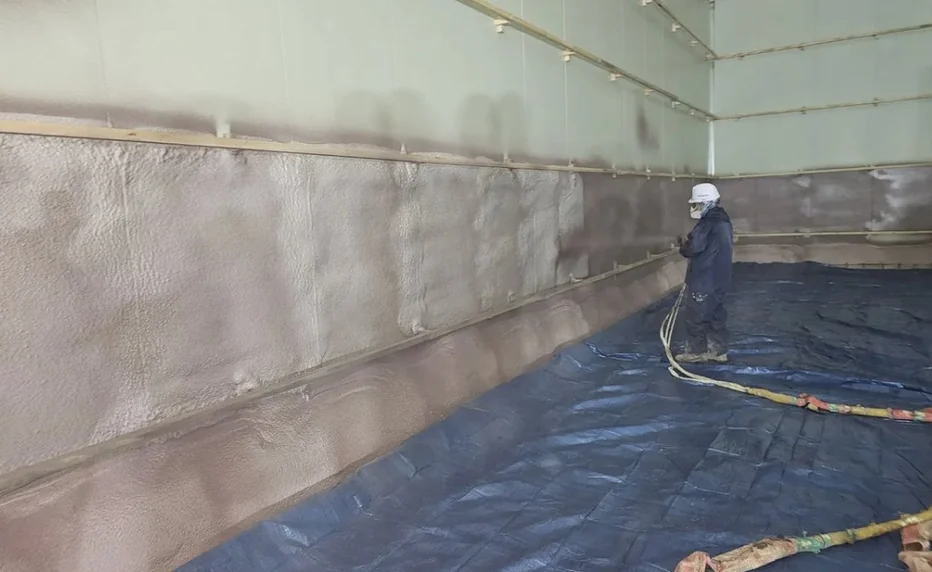
AP Tech. has been supplying Spray PU Foam Systems since 2004, and AF-1000 PIR Foam, which has passed the Korean flame-retardant standard for Quasi-noncombustible Foam, has received favorable evaluations. These formulation technologies are applied to the AF-1000 PIR Foam system design.
1. Foam Description
PU Foam is structurally composed of small honeycomb cellular structures made up of Cells. Due to this honeycomb structure, it is lightweight and provides cushioning, making it suitable for various applications such as insulation materials, mattresses, sofas, and automotive seat cushions.
PU Foam is generally divided into Rigid Foam and Flexible Foam depending on its application.
• Rigid Foam (Insulation materials): Cells have an independent structure (Closed cell). Higher Closed cell content (%) provides better insulation performance.
• Flexible Foam (Mattresses, automotive seats): Cells are interconnected (Open cell), allowing smooth air circulation and providing cushioning properties. Elasticity is improved through Polyol System formulation that enhances resilience.
2. Spray PU Foam Polyol System Formulation Technology
Factors Affecting Low Thermal Conductivity (K-f) and Foam Shrinkage (Dimensional Stability)
1) Selection of Freon Gas
a. Closed Cell and Thermal Conductivity
Inside the Closed cell structure of Rigid Foam, Freon gas with one of the lowest thermal conductivity values on earth is trapped, resulting in excellent insulation performance. Among the five major reactive resin systems, PU is capable of forming this honeycomb structure effectively, making the selection of Polyol an important factor.
b. Regulatory Transition
Due to greenhouse gas regulations (ODP, GWP), some countries are still using 141b, while the industry is transitioning from 245fa to HFO.
c. Formulation Challenges
The use of low boiling point materials such as 245fa or HFO-1233zd can create difficulties in Spray formulation development, and AP Tech. manufactures and supplies products in response to customer requirements. AP Tech. possesses formulation technology that simultaneously secures low thermal conductivity and shrinkage stability in Spray PU Foam Systems by controlling these variables.
d. Physical Property Comparison
| Item | Air | CO₂ | HCFC-141b | HFC-245fa | HFO-1233zd |
|---|---|---|---|---|---|
| Molecular Formula | N₂/O₂ Mixture | CO₂ | C₂H₃Cl₂F | C₃H₃F₅ | C₃H₂ClF₃ |
| Molecular Weight | 29 | 44 | 117 | 134 | 131 |
| Thermal Conductivity (mW/m·K) | 26 | 15 | 10.1 | 12.2 | 9.9 |
| Boiling Point (°C) | — | — | 32 | 15 | 19 |
| ODP | 0 | 0 | 0.11 (Regulated) | 0 | 0 |
| GWP | 0 | 1 | 725 | 1030 | ~1 (Low) |
| Flammability | None | None | None | None | None |
2) Effect of Low Density
PU Rigid Foam exhibits the lowest thermal conductivity within the density range of 30~40 kg/m³. Since the density of Non Foam is approximately 100 kg/m³, it is expanded approximately 33 to 25 times, and this low density is a major factor affecting Foam shrinkage.
3) Amount of Water
Excessive water usage generates large amounts of CO₂, affecting K-f and shrinkage, therefore an appropriate amount of approximately 1~2% is recommended.
4) Selection of Polyol and Raw Materials
a. Design Principle
Raw material selection should consider both excellent insulation performance and economic efficiency.
b. Polyol Composition
For Polyol, using 20~30% Ester Polyol with a small amount of Aromatic base PPG provides good results.
c. Crosslinker
For shrinkage control, selecting an appropriate Crosslinker at approximately 5~10% is recommended.
d. Silicone Surfactant
Silicone mainly functions as a Surfactant and Cell Regulator. In terms of silicone structure, the Si-O backbone (gas) + Polyether chain (polyol) provides a surfactant effect while also functioning as a Cell regulator that creates isotropic Cell structures. This is a major factor affecting shrinkage and mechanical properties.
In addition, it controls the thickness of the Cell Wall and Cell Window, making it one of the most important raw materials influencing low thermal conductivity and non-shrinkage formulation. Various silicone types should be tested to identify the most suitable formulation.
e. Catalyst Selection
Two types of Amine catalysts are mainly used:
• Blowing Catalyst: Initial reaction, Cream time (CT) control
• Gelling Catalyst: Gel time (GT) control
In special cases, Metal Catalyst (post-curing acceleration) may also be used in small quantities.
3. MDI (A Component)
General-purpose Polymeric MDI (31% NCO, viscosity 200 cPs/25℃, functionality f=2.7) is commonly used.
Precautions
• Acidity: Since there are differences in Acidity depending on the MDI manufacturer, confirmation before use is recommended. High acidity may slow reaction speed, especially during winter conditions.
• Foam Color: Foam Color differences may also occur depending on the MDI source.
Conclusion — 20+ Years of Formulation Know-how
In addition to these formulation technologies, many variables may arise during on-site Spray application. These topics will be covered in the next column.
These technologies form the core design basis of the APTECH AF-1000 PIR Foam system, enabling both insulation performance and long-term stability.
Through the columns currently being published, we hope to create opportunities to share the formulation technology and field Know-how accumulated over more than 20 years by AP Tech. with potential customers.
FAQ
Spray PU Foam Formulation Key Summary
The insulation performance of Spray PU Foam is determined by factors such as Closed cell structure, internal gas (Freon), Polyol System formulation, density, and water content. Controlling these variables is essential for securing insulation performance and long-term stability.
The thermal conductivity of the gas inside the Closed cell structure and the ability to maintain that Cell structure are the key factors. Stable implementation depends on Polyol System design and formulation technology, which directly affect Spray PU Foam System performance.
APTECH designs Spray PU Foam Systems based on formulation technology that integrates Polyol System design, Freon gas selection, Silicone structure control, and catalyst reaction design. This allows both insulation performance and shrinkage stability to be secured.
AF-1000 is a PIR Foam system that satisfies Korean Quasi-noncombustible standards. It is designed to provide insulation performance together with fire safety considerations, making it suitable for industrial and architectural insulation environments.