Expert knowledge and insights on polyurethane technology,
waterproofing systems, and industrial chemical solutions.
Key Factors Determining the Durability of Urea Coating Waterproofing Systems — Material, Design, and Application Management
Why KS F 4922 (Polyurea Resin Waterproofing Membrane Coating) Is So Demanding, and How APTECH UA-1001 Meets It

APTECH is a manufacturer with over 20 years of experience in developing and supplying raw materials for Spray Polyurea Coating and Polyurethane Foam Systems. In addition to offering products suitable for a wide range of applications, APTECH has earned a strong reputation for providing competitive specifications tailored to specific site conditions.
Following the previous column, this article examines the key factors that determine the durability of Urea Coating waterproofing systems: Material, Design, and Application Management. In particular, in the area of Material, we will introduce KS F 4922 (Polyurea Resin Waterproofing Membrane Coating), a Korean standard known for its highly demanding performance requirements. APTECH’s product certified to this KS standard is UA-1001.
Durability Is the Key to Waterproofing
Even if a waterproofing system appears flawless on the surface, it cannot truly be considered waterproof if even a minor crack develops because the system cannot withstand contraction and expansion (Movement) caused by severe seasonal climate changes or subtle structural movement (Behavior) of the building.
Waterproofing is either 0 (Zero) or 100. In waterproofing, 99% success ultimately means 100% failure. Therefore, long-term durability—the ability to maintain the initial waterproofing performance consistently over an extended period—is one of the most critical factors in determining the service life of a building.
The key system factors that determine waterproofing durability can be explained through the 3Ms.
1. Material
A high-performance resin capable of withstanding severe Complex Degradation is required, such as products that meet KS F 4922 (Polyurea Resin Waterproofing Membrane Coating).
APTECH UA-1001 has been certified as compliant with this standard, comfortably exceeding its requirements.
2. Mechanism – Design
A flexible system design that accommodates building contraction and expansion and external impact is important, along with selecting the optimal waterproofing material and thickness for each application.
3. Management of Application
Proper substrate preparation for strong adhesion, the use of a suitable primer, maintaining the correct mixing ratio and uniform pressure through proper Spray Machine operation, and site management to prevent application defects such as dew point and condensation are important.
Among the Material factors above, we will introduce the Korean evaluation standard for high-performance waterproofing materials.
The test standard is KS F 4922 (Polyurea Resin Waterproofing Membrane Coating).
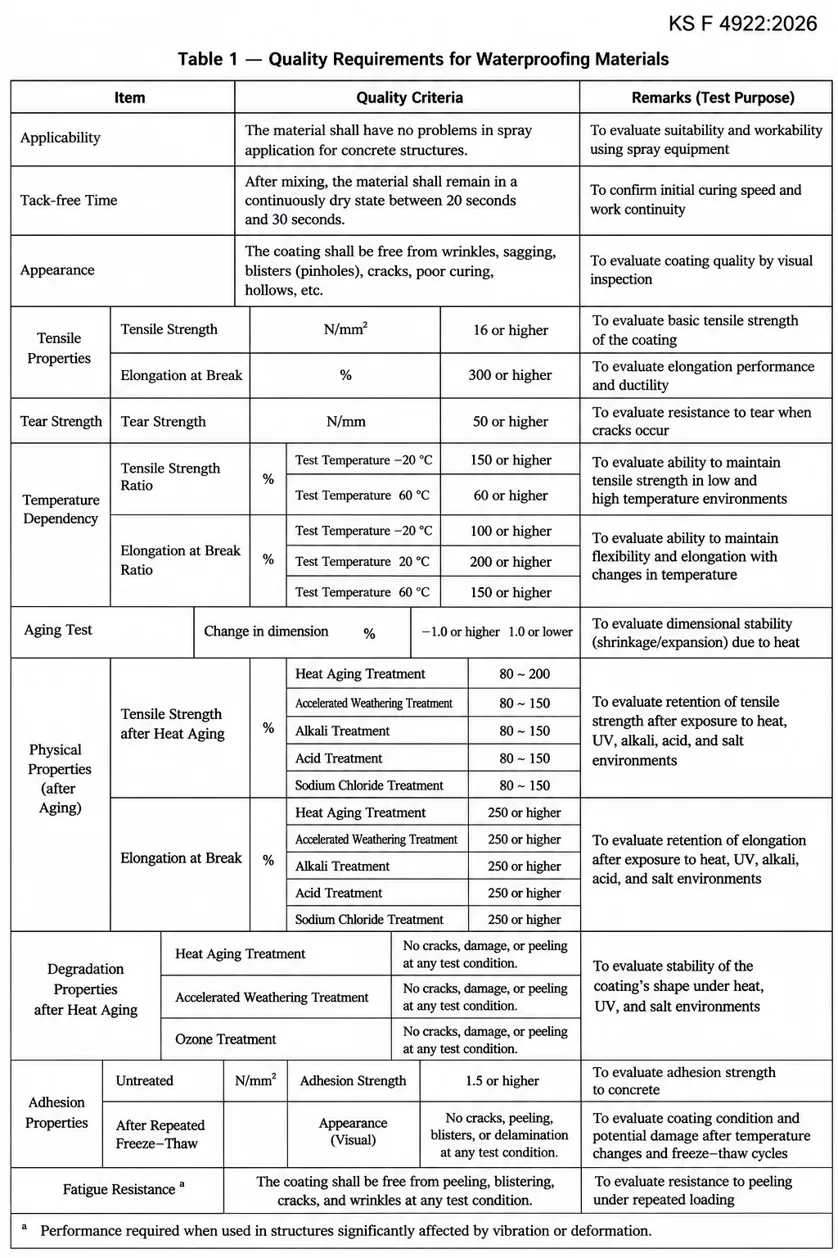
KS F 4922 consists of six major categories and 28 detailed test items, all of which are extremely difficult to satisfy simultaneously.
For reference, a comparison with KS F 3211, the standard for 2K manually applied PU waterproofing materials, demonstrates the outstanding performance of Polyurea.
A. KS F 4922 vs. KS F 3211 Comparison
Note: Comparison data from selected requirements of the full standards.
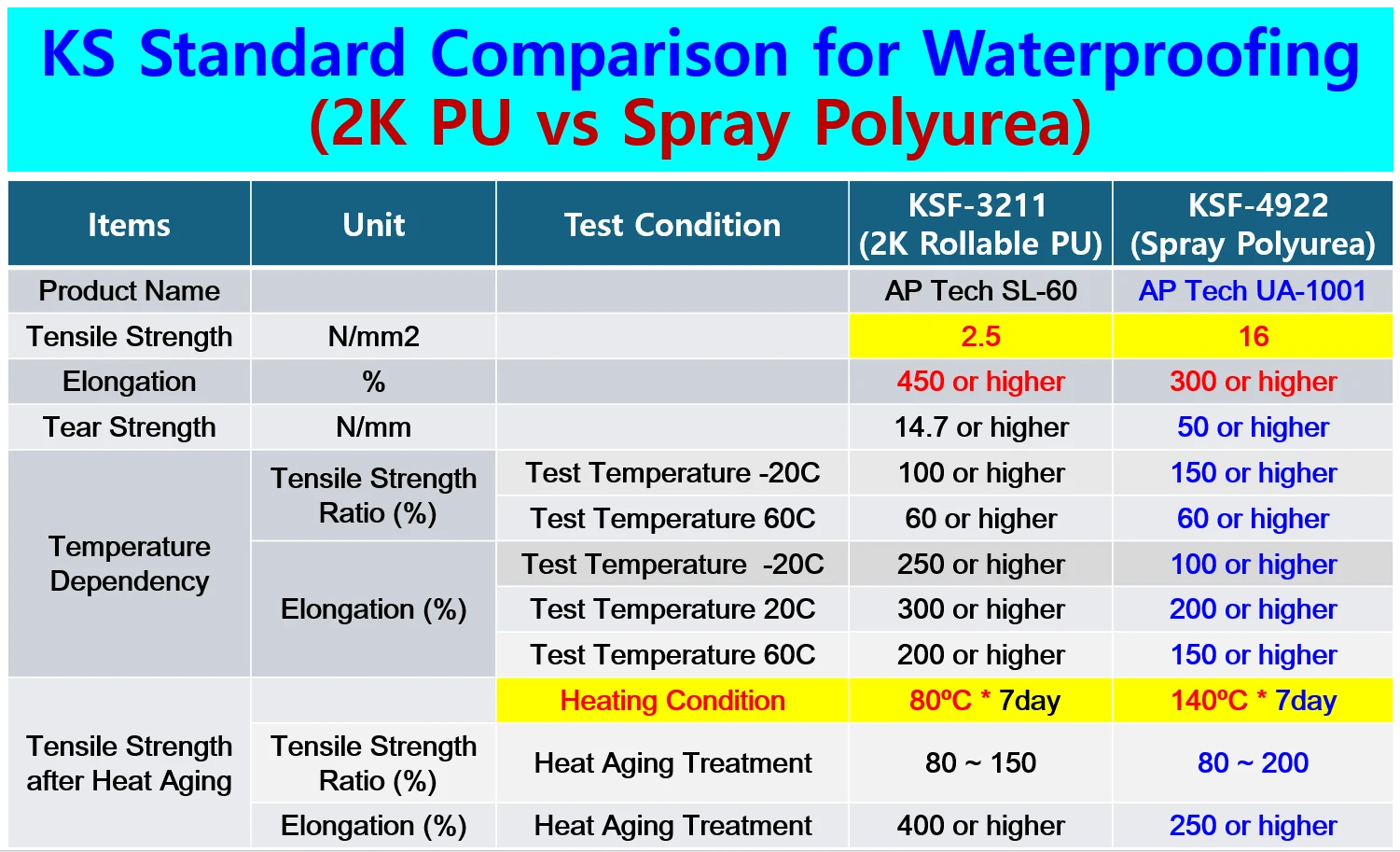
The KS F 4922 (Polyurea Resin Waterproofing Membrane Coating) standard was first established on June 8, 2000. Since then, it has undergone several revisions in response to changes in construction and civil engineering environments and the advancement of national standards.
Revisions: 2005, 2007, 2022
Latest Revision: February 12, 2026
(Reflecting conditions similar to outdoor degradation factors, including accelerated test equipment conditions)
KS F 4922 is a Korean Industrial Standard that specifies the quality requirements and test methods for Spray Polyurea waterproofing membrane coatings used on concrete structures. In addition to tensile and tear properties and adhesion strength, it measures temperature dependence, tensile strength retention (%) and elongation (%) after degradation treatment to verify long-term waterproofing reliability under extreme cold and heat, as well as exposure to acidic and alkaline environments.
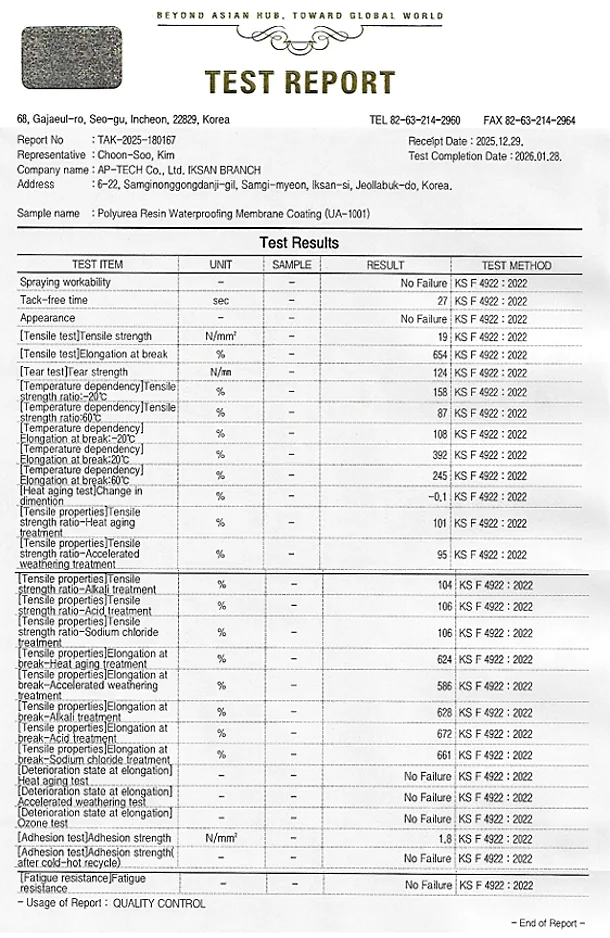
APTECH obtains a test report once a year, and APTECH UA-1001 has been certified as compliant, comfortably exceeding the requirements of this standard.
Now, we will explain the test items and details of KS F 4922.
B. KS F 4922 Test Items and Details
The table below presents the KS F 4922 test requirements, with the purpose of each test described in the Remarks column on the right.
C. Reference: KS F 4922 Test Report for APTECH UA-1001 (2026)
D. Why It Is Difficult to Pass KS F 4922
The main reason KS F 4922 is difficult to pass is that high tensile performance and Crack Bridging capability must be maintained simultaneously even under severe Complex Degradation conditions.
This standard evaluates not only whether the material is strong when initially produced, but also whether it maintains a similar level of elasticity and strength after exposure to a wide temperature range, strong UV radiation, acid rain, concrete alkalinity, and extreme winter cold. For this reason, the requirements are extremely stringent.
Spray Polyurea Waterproofing Coating is the only waterproofing material capable of meeting these requirements. Below, we will explain why conventional waterproofing materials have difficulty meeting this standard.
1. Severe Temperature Dependence Test from -20°C to 60°C
The material must maintain at least 150% of its initial tensile strength at -20°C and at least 150% elongation at 60°C, among other requirements.
In extreme winter cold (-20°C), waterproofing materials can harden like organic glass and become brittle, making them prone to fracture even under slight tension. At high summer temperatures (60°C), they can become too soft and easily lose strength.
Since waterproofing materials must withstand all four seasons, it is difficult for conventional materials to prevent deterioration of physical properties caused by temperature changes.
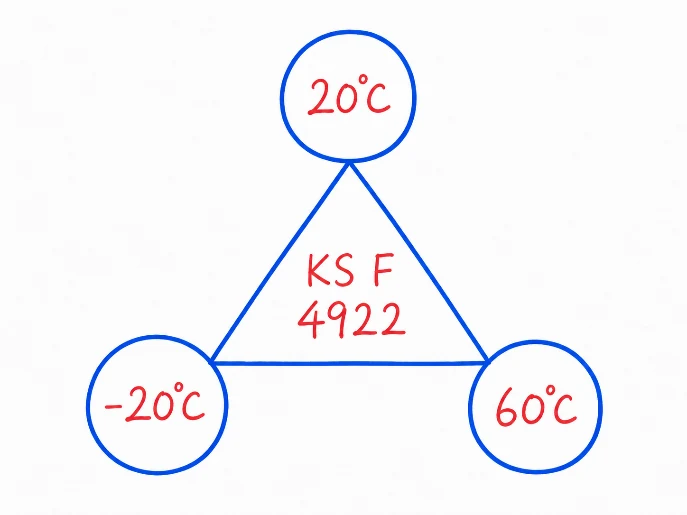
In particular, during the development of the KS-compliant product, it was extremely difficult to satisfy the three conditions shown in the Triangle below simultaneously.
When two conditions were met, one would be Out of Spec.; when another two were met, the remaining condition would fall Out of Spec.
This was because the product had to simultaneously achieve two theoretically conflicting performance targets: High Tensile Strength and High Elongation.
2. Performance Requirements After Five Types of Combined Physical and Chemical Degradation
Even after exposure to the following five severe degradation conditions, the material must maintain at least 80% of its initial tensile strength and at least 250% elongation.
• Heat Aging Treatment
Long-term exposure to high temperatures
• Accelerated Weathering Treatment
Simulated seasonal weathering and UV exposure
• Alkali Treatment
Immersion in the strong alkaline environment characteristic of concrete
• Acid Treatment
Simulation of acid rain exposure
• Sodium Chloride Treatment
Immersion in salt water
These tests are difficult because UV radiation and acidic and alkaline chemicals can break down the molecular chains of waterproofing materials, resulting in deterioration of their physical properties.
In addition, when waterproofing materials are exposed to alkaline components from concrete or salts in seawater, the material itself can deteriorate. Therefore, without excellent physical and chemical resistance, most conventional waterproofing materials fail to meet the required performance after degradation.
3. Crack Bridging Requirements After Degradation
Even after undergoing the severe degradation processes described above, the coating must withstand cracks generated in the concrete substrate without cracking, damage, or delamination.
Conventional waterproofing materials that have aged after exposure to the conditions described above generally lose their elasticity and become prone to tearing.
The ability to withstand microcracks and cracks in concrete even under such severe conditions demonstrates that Spray Polyurea is a material with excellent long-term durability.
APTECH Polyurea Waterproofing Products
For various application sites, we recommend APTECH UA-1001, a Polyurea Resin Waterproofing Membrane Coating that fully meets the requirements of KS F 4922.
We also recommend considering APTECH EPL-550, our Top-Selling Waterproofing Product offering excellent cost-effectiveness.
We hope the information provided in this column will be helpful to our customers in their work.
FAQ
Spray Polyurea Waterproofing & KS F 4922
The key system factors that determine waterproofing durability are Material, Mechanism (Design), and Management of Application. Material refers to high-performance resins that withstand severe Complex Degradation; Mechanism refers to flexible structural design for building contraction, expansion, and external impact, as well as the selection of optimal waterproofing materials and thicknesses; and Management of Application refers to site management such as substrate preparation, suitable Primer use, proper Spray Machine operation, and prevention of dew point and condensation.
KS F 4922 is a Korean Industrial Standard for the quality and test methods of Polyurea Resin Waterproofing Membrane Coating. It evaluates tensile and tear performance, adhesion, temperature dependence, tensile strength retention (%) and elongation (%) after degradation treatment to verify long-term waterproofing reliability under extreme cold and heat, and exposure to acidic and alkaline environments.
The main reason is that high tensile performance and Crack Bridging must be maintained simultaneously under severe Complex Degradation conditions. It verifies whether the material maintains a similar level of elasticity and strength even after exposure to a wide temperature range, strong UV radiation, acid rain, concrete alkalinity, and extreme winter cold.
The material must maintain at least 150% of its initial tensile strength at -20°C and at least 150% elongation at 60°C, among other requirements.
The following five physical and chemical degradation conditions are evaluated: Heat Aging Treatment, Accelerated Weathering Treatment, Alkali Treatment, Acid Treatment, and Sodium Chloride Treatment. Even after exposure to these severe conditions, the material must maintain at least 80% of its initial tensile strength and at least 250% elongation.
Even after severe degradation, the coating must withstand cracks in the concrete substrate without cracking, damage, or delamination. This ability to withstand microcracks and cracks in concrete even under such severe conditions demonstrates the excellent long-term durability of Spray Polyurea.
APTECH’s KS F 4922-compliant product is UA-1001. APTECH obtains a test report once a year, and UA-1001 comfortably exceeds the requirements of KS F 4922 and has been certified as compliant.