Expert knowledge and insights on polyurethane technology,
waterproofing systems, and industrial chemical solutions.
Comparison of Epoxy, Polyurethane, and Spray Polyurea Flooring and Waterproofing Systems
A Manufacturer's Guide to Selecting Industrial Waterproofing Systems: Development History · Physical Properties · Applications

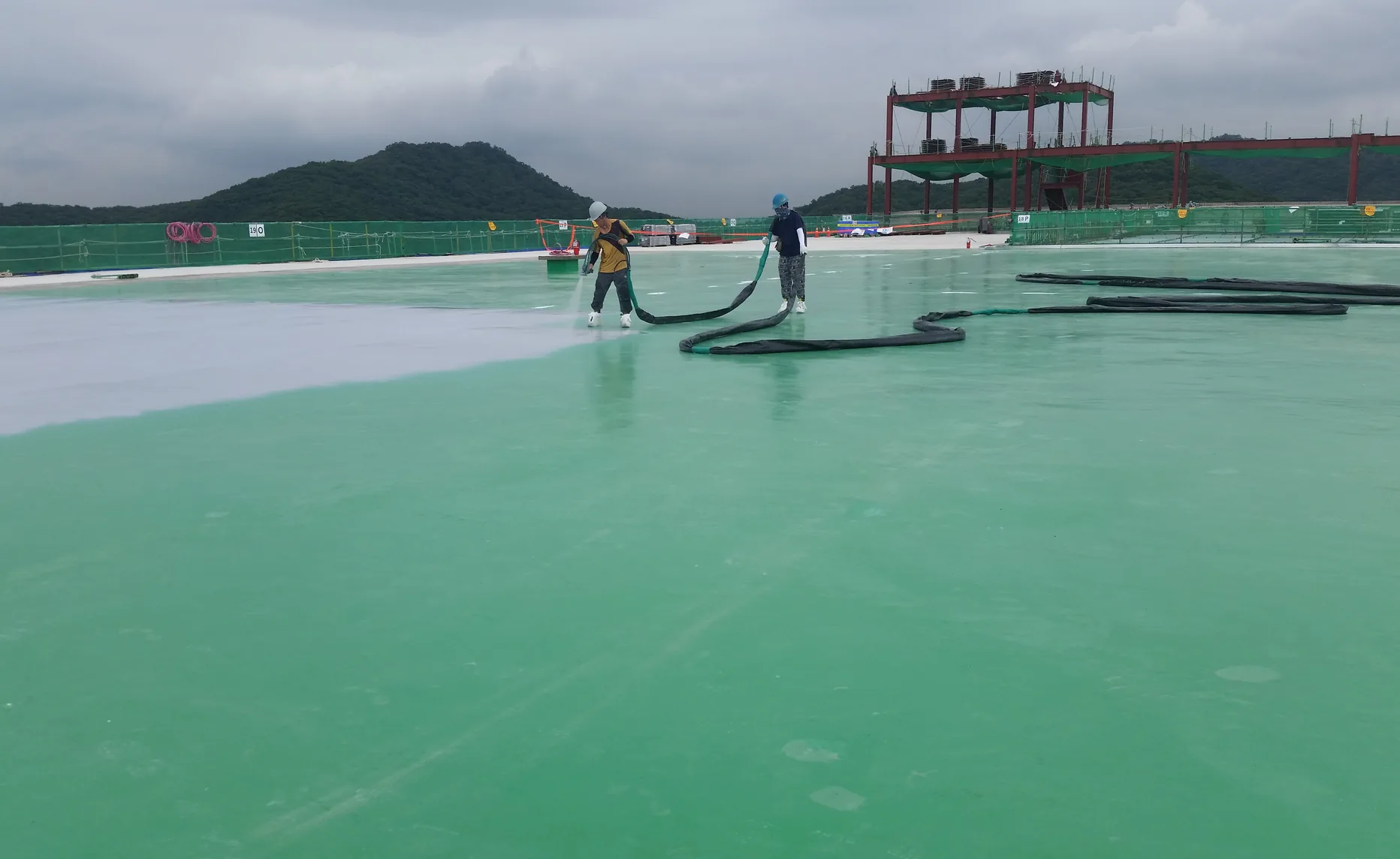
Industrial flooring and waterproofing systems are key to the service life and maintenance costs of structures. Selecting the right material for the service environment and required performance is critical to long-term durability and application quality.
Since 2004, APTECH has developed and manufactured Spray Polyurea Systems, provided on-site Technical Service (T/S), and supplied waterproofing and protective coating solutions to various industrial sites, expanding its reach through exports.
APTECH manufactures a wide range of products, including Polyurea Waterproofing, Polyurea Flooring, Polyurea Anti-Corrosion Coating, EPS Hard Coating, and Polyurethane Waterproofing, and recommends systems suited to each project environment.
The most commonly compared flooring and waterproofing systems in industrial applications are Epoxy, Rollable Polyurethane (PU), and Spray Polyurea. All are two-component (2K) systems that form a coating film, but differ in their development backgrounds, physical properties, and applications. Equal performance should not be expected simply because they are all flooring and waterproofing materials; the appropriate system should be selected to match the structure's intended use and application environment.
This column examines Epoxy, Rollable Polyurethane, and Spray Polyurea by comparing their development histories, characteristics, basic formulations, and factors affecting mechanical properties.
When Were Epoxy, Polyurethane, and Spray Polyurea Developed?
The major flooring and waterproofing systems used in industrial applications today were developed to meet different industrial needs.
Epoxy was the first floor coating material to be commercialized and is widely used for factory, warehouse, parking facility, and commercial facility floors due to its high hardness and abrasion resistance.
Rollable Polyurethane was developed to provide a more flexible waterproofing system, and its use has expanded primarily to rooftop waterproofing and elastic flooring for indoor and outdoor applications.
Spray Polyurea is the most recently commercialized technology and is used for indoor and outdoor concrete waterproofing, industrial floors, parking facilities, and anti-corrosion coatings due to its ultra-fast curing and excellent mechanical properties. In particular, its use across a wide range of industrial sites has expanded since dedicated spray equipment became widely available.
Development History of Epoxy, Rollable Polyurethane, and Spray Polyurea
A. Development and Commercialization Years of Epoxy, Hand-Applied PU, and Spray Polyurea Flooring and Waterproofing Systems
| Material | Development Year | Commercialization Year | Flooring & Waterproofing Adoption |
|---|---|---|---|
| Epoxy | 1934~1936 Joint research in Germany and Switzerland |
1946 Launched at an exhibition in Switzerland |
Late 1950s Introduced as an industrial flooring material |
| Hand-Applied Polyurethane (Rollable Polyurethane) |
1937 Germany, Dr. Otto Bayer |
1950s Commercialized as a PU coating |
1970s~1980s Widespread adoption for rooftop waterproofing |
| Spray Polyurea | 1986 Texaco Chemical, USA (currently Huntsman) |
1989 First commercialized in the United States as a roof waterproofing material (with the introduction of spray equipment) 2004 — APTECH began system manufacturing, sales, and T/S |
Early 2000s Widespread adoption of dedicated spray equipment (Gusmer H-3500, currently Graco H-XP3, etc.) |
What Are the Differences Between Epoxy, Rollable Polyurethane, and Spray Polyurea?
All three systems are used for floor protection and waterproofing, but their required properties differ significantly.
Epoxy is widely used for indoor industrial flooring due to its high hardness and excellent abrasion resistance. Rollable Polyurethane uses its elasticity and waterproofing performance in rooftop waterproofing and elastic flooring.
Spray Polyurea combines high elongation and tensile strength with ultra-fast curing. It forms a continuous waterproofing membrane on horizontal, vertical, and curved surfaces and is therefore used across various industrial sites. It is also used where abrasion, corrosion, and chemical resistance are required.
Comparison of Epoxy, Rollable Polyurethane, and Spray Polyurea Characteristics
| Category | Epoxy | Hand-Applied Polyurethane (Rollable Polyurethane) |
Spray Polyurea |
|---|---|---|---|
| Hardness | Hard (rigid, high hardness), brittle | Flexible (soft, elastic), elongates | Flexible (soft, elastic), elongates |
| Applications | • Concrete surface protection (indoor factory and warehouse floors, parking garage floors, commercial facility floors) • Abrasion resistance • Corrosion resistance • Chemical resistance |
• Horizontal-surface waterproofing (rooftop waterproofing, elastic flooring for indoor and outdoor sports facilities, some parking garage floors) | • Waterproofing of all surfaces (horizontal, vertical, and curved surfaces; indoor and outdoor concrete waterproofing; parking garage floors) • Abrasion resistance • Corrosion resistance • Chemical resistance |
| Disadvantages | • Minimal elongation; risk of cracking and leakage • Slow curing |
• Low tensile strength; durability issues • TDI subject to hazard regulations • Slow curing |
• High cost; competitive over the long term |
| Advantages | Low cost (thick-film and thin-film systems) | Low to moderate cost (thick-film system) | • High elongation and high tensile strength overcome the limitations of other materials • Ultra-fast curing (thick-film system) |
| Reasons for Low Cost | Large amounts of filler and silica sand used | • Fillers and solvents used • PPG and TDI used (recent shift to MDI due to hazard concerns) |
— |
| Reasons for High Cost | — | — | • No fillers or solvents used • Polyamine and MDI used |
| Weather Resistance | Low (susceptible to UV exposure and temperature changes; discoloration and cracking) | Good. Topcoat recommended | Excellent. Topcoat recommended |
Why Are Fillers Not Used in Spray Polyurea?
The performance of flooring and waterproofing systems depends on their raw materials and basic formulations. One key difference among Epoxy, Rollable Polyurethane, and Spray Polyurea is whether fillers and silica sand are used.
Depending on the application, Epoxy and Rollable Polyurethane use fillers to increase hardness, control leveling, prevent shrinkage, improve abrasion resistance, and reduce costs. Common fillers include extender pigments such as Ground Calcium Carbonate (GCC) and Talc.
Spray Polyurea, however, uses neither fillers nor silica sand. This filler-free formulation is a basic manufacturing characteristic of Spray Polyurea and an important feature in high-performance waterproofing and protective coating applications.
Comparison of Basic Formulations for Epoxy, Rollable Polyurethane, and Spray Polyurea
| Category | Epoxy Lining | Hand-Applied Polyurethane (Rollable Polyurethane) |
Spray Polyurea |
|---|---|---|---|
| Curing Agent | Polyamide Amine Adduct Jeffamine Diamine |
Isocyanate Prepolymer Approx. 5~10% NCO |
Isocyanate Prepolymer Approx. 10~20% NCO |
| Resin | 50 | 70 | 95 |
| Filler (Ground Calcium Carbonate, Talc, Silica, etc.) |
40 | 20 | — |
| Moisture Scavenger | — | 1 | — |
| Reactive Diluent | 4 | — | — |
| Plasticizer | — | 3 | — |
| Pigment | 3 | 3 | 4 |
| Defoamer | 1 | 1 | 1 |
| Leveling Agent | 1 | 1 | — |
| Anti-Settling Agent | 1 | 1 | — |
| Total | 100 | 100 | 100 |
| *On-Site Addition | Silica sand may be added | No on-site addition | No on-site addition |
* Example base-component formulation values. Actual formulations vary by product and application environment.
What Determines Mechanical Properties and Adhesion?
The performance of flooring and waterproofing systems is not determined by material type alone. Even products of the same Epoxy or Polyurethane type can differ significantly in mechanical properties and adhesion depending on the raw materials used and molecular design.
Product selection should therefore consider not only the material name but also the resin and hardener used and how the molecular structure is designed.
1. Epoxy Reaction
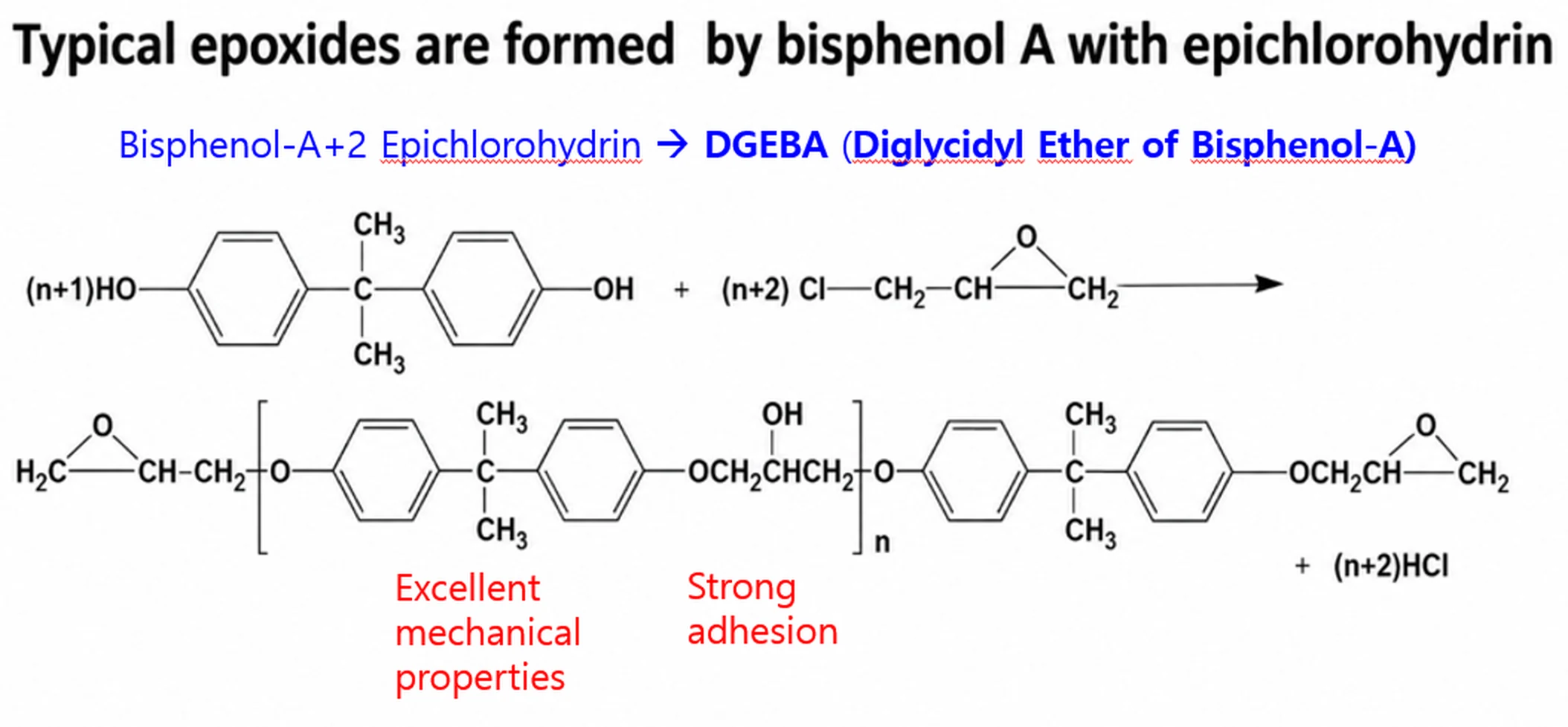
The properties of Epoxy are determined by the combination of epoxy resin and hardener.
Epoxy Reaction Example
Epoxy Resin + NH₂-R → CH(OH)-CH₂-NH-R
Mechanical properties and adhesion depend on the structures of the epoxides and hardener used.
2. Polyurethane Reaction
Polyurethane follows a common basic reaction, but actual product performance varies with the molecular design of its raw materials.
Example Polyurethane Reaction
Polyurethane: R—N=C=O + R′—OH → R—NH—CO—O—R′
Mechanical properties and adhesion depend on the structures bonded to R and R′. Molecular design around the urethane linkage is therefore the key point.
Epoxy Resin Selection Varies by Application
Not all Epoxy systems provide the same performance. The appropriate Resin and Hardener must be selected for the application environment to achieve the required performance.
For general industrial flooring, cost-effectiveness and corrosion resistance are important. In chemical plants or marine structures, however, chemical resistance, heat resistance, or curing performance in wet environments becomes more critical.
Examples of Epoxy Resins and Hardeners by Application
| Application | Epoxy Resin | Hardener | Characteristics |
|---|---|---|---|
| Epoxy Lining | DGEBA | Polyamide | General-purpose Corrosion resistance Cost-effectiveness |
| Food Processing Plant | DGEBF | Cycloaliphatic Amine | Low viscosity Surface smoothness Chemical resistance |
| Chemical Plant | Novolac | Cycloaliphatic Amine | Crosslink density Heat resistance Chemical resistance |
| Marine | DGEBA | Phenalkamine | Curing under damp conditions Low-temperature curing Seawater resistance |
Industrial Waterproofing Systems Recommended by APTECH
Industrial flooring and waterproofing systems should not be selected based on initial material cost alone. To ensure long-term performance, the most suitable system must be selected by considering the structure's service environment, application conditions, required properties, and maintenance plan.
Since 2004, APTECH has developed and manufactured Spray Polyurea Systems and provided on-site Technical Service (T/S), supplying solutions suited to a wide range of industrial sites. Drawing on its accumulated manufacturing expertise and field experience, APTECH recommends systems that meet customer requirements and supports reliable application and quality assurance through product supply and Technical Service.
APTECH currently manufactures a wide range of products for Polyurea Waterproofing, Polyurea Flooring, Polyurea Anti-Corrosion Coating, EPS Hard Coating, and Polyurethane Waterproofing. These products support a broad range of applications, including industrial floors, parking facilities, concrete structures, and protective coatings.
Performance requirements vary by project. As a manufacturer, APTECH draws on its technical expertise and field experience to recommend waterproofing and protective coating systems suited to each customer's application environment. APTECH will continue to provide competitive Polyurea and Polyurethane solutions through ongoing R&D and quality improvement.
FAQ
Flooring & Waterproofing System Selection Key Summary
All three are two-component (2K) flooring and waterproofing systems, but they differ in intended use and physical properties.
Epoxy is widely used for floors in industrial plants, warehouses, parking facilities, and commercial facilities due to its high hardness and abrasion resistance.
Rollable Polyurethane is used in hand-applied applications, such as rooftop waterproofing and elastic flooring, due to its flexible coating properties.
Spray Polyurea combines high elongation and tensile strength with ultra-fast curing. It is used for indoor and outdoor concrete waterproofing, industrial floors, parking facilities, anti-corrosion coatings, and various other industrial applications.
Depending on the application, Epoxy and Rollable Polyurethane may use fillers to improve physical properties and reduce costs.
Spray Polyurea, however, uses neither fillers nor silica sand. This is a fundamental manufacturing characteristic of Spray Polyurea and an important feature in high-performance waterproofing and protective coating applications.
Spray Polyurea is suitable for sites requiring ultra-fast curing, high elongation, excellent tensile strength, abrasion resistance, corrosion resistance, and chemical resistance.
It is used for indoor and outdoor concrete waterproofing, industrial floors, parking facility floors, waterproofing of horizontal, vertical, and curved surfaces, and anti-corrosion coatings across a wide range of industrial applications. In recent years, its use has continued to expand, especially in projects where application efficiency and long-term durability are important.
A flooring and waterproofing system should be selected by considering the structure's service environment, required properties, application conditions, and maintenance plan rather than initial material cost alone.
Even within the same material category, the appropriate system may vary according to its intended application. Selecting the right material for each project is essential to ensuring long-term performance.
The use of Spray Polyurea continues to expand in industrial waterproofing and protective coating applications due to its ultra-fast curing, high elongation and tensile strength, and excellent abrasion, corrosion, and chemical resistance.
To meet these industry needs, APTECH has developed and manufactured Spray Polyurea Systems and provided on-site Technical Service (T/S) since 2004. APTECH currently supplies a wide range of products for Polyurea Waterproofing, Polyurea Flooring, Polyurea Anti-Corrosion Coating, EPS Hard Coating, and Polyurethane Waterproofing and recommends solutions suited to each project's requirements.
Product performance may vary depending on site conditions and system design. Based on its manufacturing technology and field experience, APTECH continues to develop and supply Spray Polyurea and Polyurethane Systems that meet customer performance requirements.